- Call us Via Whatsapp: +84 (0) 832 126 699
4.9 stars on our site
(15,000 reviews)
- Monday - Sunday : 08:00 - 17:00
(15,000 reviews)

By The Golden Cycling Tours Team
There are bike rides, and then there are odysseys. There are routes you ride for fitness, and routes you ride to change your perspective on the world. The Ha Giang Loop, winding through the northernmost frontier of Vietnam, belongs firmly to the latter category.
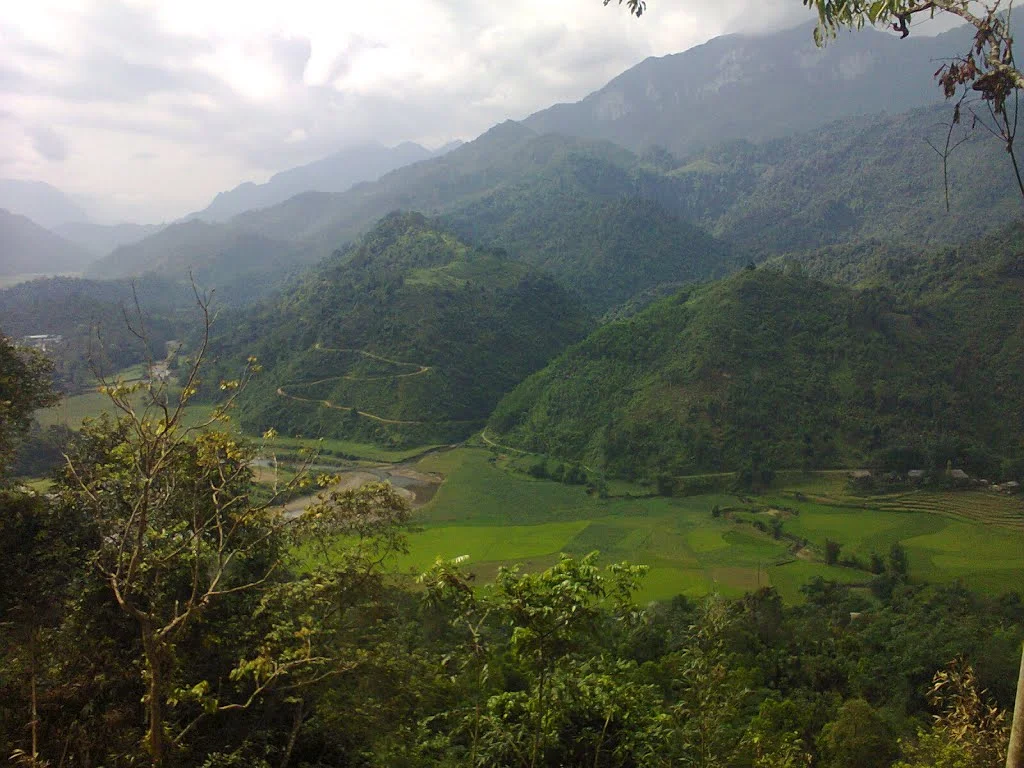
For years, this region was a forbidden land, a remote border zone accessible only to military personnel and intrepid locals. Today, the Ha Giang Loop has opened its gates, revealing a landscape of geological violence and breathtaking beauty. It is a world of limestone karsts that pierce the clouds, serpentine roads that defy gravity, and colorful ethnic minority cultures that have thrived in isolation for centuries.
But let us be clear from the first pedal stroke: This is not a Sunday cruise.
This guide is for the climbers. The grinders. The cyclists who look at an elevation profile that resembles a jagged saw blade and say, "Yes."
In this comprehensive guide, brought to you by Golden Cycling Tours, we will dissect the Ha Giang Loop for the serious cyclist. We will cover the brutal gradients, the mesmerizing Ma Pi Leng Pass, the essential weather windows to avoid landslides, and why a supported tour is the smartest way to tackle Vietnam’s final frontier.
While the coastal route from Hanoi to Saigon offers gentle rollers, Ha Giang offers verticality. The province is dominated by the Dong Van Karst Plateau Geopark, a UNESCO Global Geopark.
A typical full loop covers approximately 300 to 350 kilometers. However, the distance is deceptive. In Ha Giang, you do not measure rides in kilometers; you measure them in vertical meters gained.
Total Elevation Gain: Expect to climb between 5,000m to 7,000m over 4-5 days.
The Gradients: Sustained climbs of 6-8% are standard. However, "kicker" sections frequently ramp up to 12%, 15%, and even 20% on the backroads.
The "Loop" is a mix of conditions. The main QL4C road is generally paved asphalt, though often narrow and winding. However, the true magic—and the challenge—lies in the detours to villages like Du Gia or the border poles. Here, the tarmac often disintegrates into gravel, broken concrete, or hard-packed dirt.
Bike Choice: Leave the aero race bike at home. You need a gravel bike with 35mm+ tires or a hardtail mountain bike. You need low gearing (a 1:1 ratio or lighter) and reliable disc brakes for the treacherous descents.
We break the loop down into the classic 4-day itinerary favored by strong cyclists.
The Challenge: The Bac Sum Pass.
The Ride: The warm-up is short. Leaving the city, you almost immediately hit the Bac Sum Pass. It is a long, winding snake of a road that lifts you out of the humid lowlands and into the cooler mountain air.
The Reward: Reaching Heaven’s Gate (Quan Ba). From the summit, you look down upon the "Twin Mountains" (Fairy Bosom Mountains), perfectly symmetrical hills rising from the rice paddies.
The Challenge: The relentless undulating hills and the Tham Ma Pass.
The Landscape: The scenery shifts dramatically. The lush green gives way to grey, jagged limestone. This is the "Rock Plateau." Locals here farm corn in the pockets of soil between sharp rocks. It is a testament to human resilience.
The Highlight: The Vuong Family Mansion (Hmong King Palace). A mesmerizing architectural blend of Chinese Manchu, Hmong, and French styles hidden in a valley of sa mu trees.
The Challenge: High altitude, wind, and vertigo.
The Ride: This is the shortest day in distance but the most profound in experience. You will conquer the Ma Pi Leng Pass.
Ma Pi Leng: Known as the "King of All Passes" in Vietnam. The road is carved directly into the cliff face at an elevation of 1,500 meters.
The View: Below you drops the Tu San Abyss, the deepest canyon in Southeast Asia, where the Nho Que River flows like a thread of turquoise turquoise silk. Stopping here for a coffee on the cliff edge is mandatory.
The Challenge: The "M Road."
The Ride: Most motorbikes take the easy highway back. Cyclists should take the road to Du Gia. This section is wild, often rough, and stunningly beautiful. It features waterfalls, smaller villages, and a sense of total isolation.
The Descent: The final drop back to Ha Giang City is a high-speed thrill that will have your rotors sizzling.
In the mountains, weather is not just about comfort; it is about safety. Ha Giang is prone to heavy fog, flash floods, and landslides.
October to November (Buckwheat Flower Season):
Pros: Dry, cool air, stunning visibility. The hills are painted pink with blooming buckwheat flowers.
Cons: It is peak tourist season, so roads can be busier.
March to May (Spring):
Pros: Warmer temperatures, flowers in bloom (peach and plum blossoms), lush greenery.
Cons: Occasional spring mist can obscure views in the early morning.
We strongly advise against cycling Ha Giang in deep summer.
The Heat: The valleys bake in 35°C+ heat with high humidity.
The Rain: This is the rainy season.
The Risk: Landslides are common. Roads can be washed out or blocked by falling rocks overnight. Descending steep passes on slick, oily roads in torrential rain is extremely dangerous.
Conditions: It gets cold. Temperatures can drop to near freezing, and the fog (suong mu) can be thick, reducing visibility to zero. If you ride in winter, you need full thermal gear.
Ha Giang is not a place for 5-star luxury resorts. The beauty of this loop is the immersion in the lives of the Hmong, Tay, Dao, and Lo Lo people.
You will likely stay in traditional stilt houses.
The Sleeping: Often on mattresses on the floor, separated by curtains and mosquito nets. It is communal, cozy, and authentic.
The Eating: "Family Style" dinners are the norm. You sit on mats with the host family. Expect mountains of rice, free-range pork, tofu, and stir-fried vegetables.
The "Happy Water": You will be offered corn wine (Ruou Ngo). It is strong, and refusing the first toast is considered impolite. However, as a cyclist facing a 10% grade the next morning, sip responsibly!
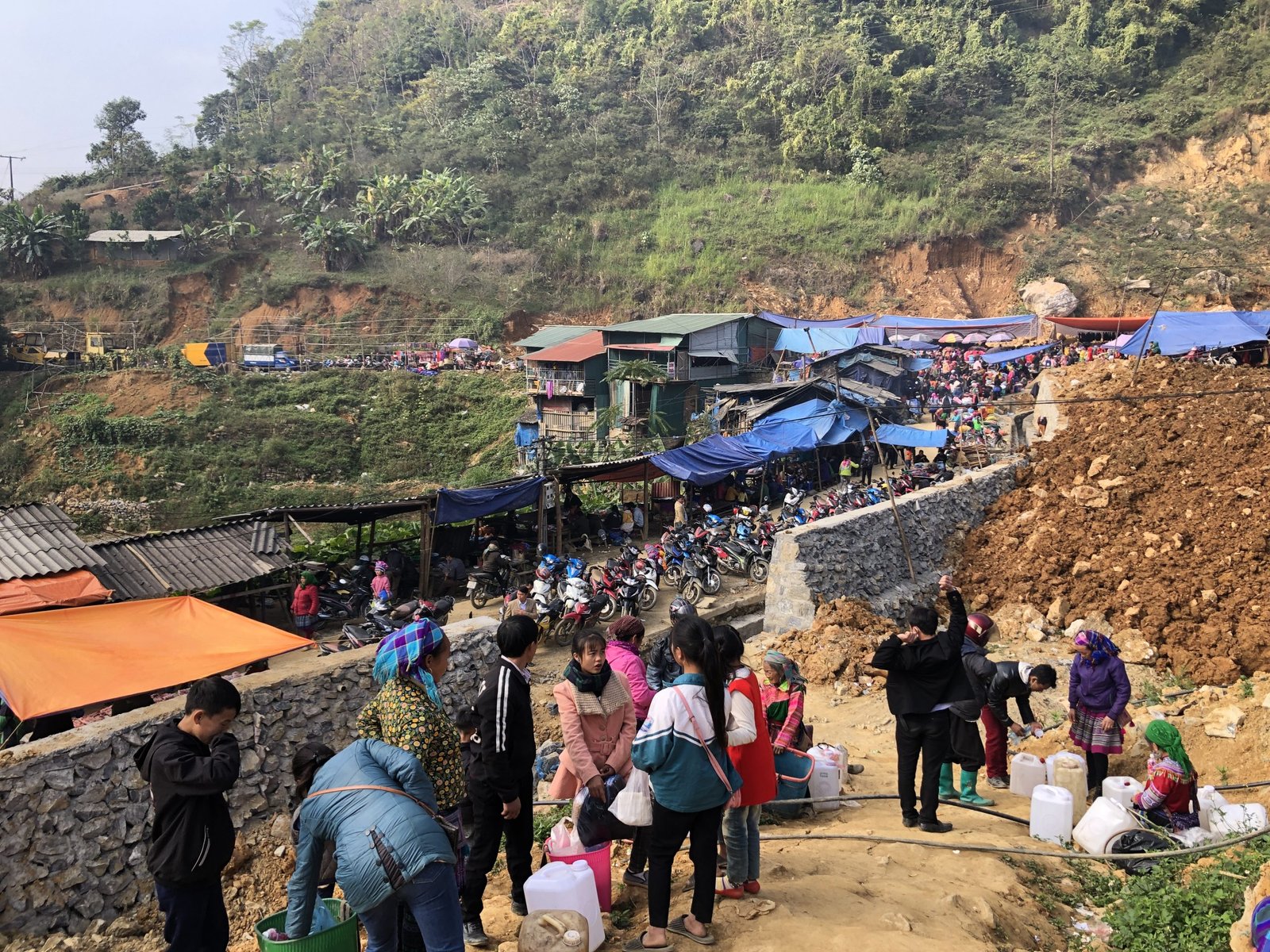
If your trip aligns with a Sunday, the Dong Van Market or Meo Vac Market is unmissable. It is a riot of color as hill tribes from surrounding villages descend to trade cattle, hemp, and goods. It is one of the most photogenic spectacles in Asia.
Cycling Ha Giang is logistically complex. This is not a place where you can easily hail a taxi if things go wrong.
Ha Giang borders China. Foreigners are required to obtain a police permit to stay overnight in Dong Van and Meo Vac. You can get this in Ha Giang City, but it takes time and paperwork.
There are no high-end bike shops in the mountains. There are motorbike mechanics who can fix a flat with a patch, but they will not have 700c tubes, derailleur hangers, or 11-speed chains.
Must Carry: Spare derailleur hanger, multiple tubes, chain breaker, quick links, spare brake pads (you will burn through them), and a comprehensive multi-tool.
Bonking on Ma Pi Leng Pass is not fun. Village shops sell water and instant noodles, but they do not sell energy gels or electrolyte tabs. You must bring your own sports nutrition.
Can you cycle Ha Giang solo? Yes, if you are an experienced bike packer with mechanical skills and Vietnamese language ability.
However, for most cyclists, a supported tour transforms this from a logistical nightmare into the ride of a lifetime. Here is why serious cyclists choose Golden Cycling Tours:
This is non-negotiable for safety.
Mechanical Failure: If your chain snaps or a rim cracks 50km from the nearest town, our van is there.
The "Bail Out": Even the strongest legs fail. If the 15% gradient becomes too much, or if the weather turns dangerous, you can hop in the van.
Luggage: Ride light. We carry your bags. You just pedal.
Our guides are expert cyclists who know every pothole and blind corner. More importantly, they know the weather patterns. We make real-time decisions to reroute if landslides threaten a specific pass.
We handle the police permits. We know the homestay owners personally. We bridge the language gap, allowing you to actually converse with the Hmong grandmother pouring your tea, rather than just smiling and nodding.
While the crowds stick to QL4C, we take you on the village single-tracks and backroads that aren't on Google Maps—where the true beauty of Ha Giang hides.
Are you ready to conquer the Northern Frontier? View our specific "Ha Giang Challenge" itinerary and bike rental options at: 👉 https://goldencyclingtours.com/
Q: How fit do I really need to be? A: Very fit. You should be comfortable climbing 1,500m+ in a single day. If you are a casual rider, we recommend our E-bike options or our coastal tours instead.
Q: Can I rent a bike suitable for Ha Giang? A: Yes. Golden Cycling Tours maintains a fleet of high-end mountain bikes (Giant/Trek) with hydraulic disc brakes and climbing gears specifically set up for these mountains.
Q: Is it safe? A: The descents are technical and the roads are unfenced cliff-edges. Caution is required. Traffic is generally light, but trucks on narrow corners are a hazard. Our guides communicate with radios to warn of oncoming vehicles.
Q: What clothes should I pack? A: Layers. The valleys are hot; the passes are cold. Bring a high-quality windbreaker/rain jacket for the descents.
"The Hardest Thing I've Ever Loved" "I've cycled the Alps and the Pyrenees, but Ha Giang is different. It's raw. The Ma Pi Leng Pass is simply spiritual. I was glad to have the Golden Cycling Tours van behind me when my derailleur took a hit from a rock. They fixed it in 10 minutes." — Thomas, Switzerland ⭐⭐⭐⭐⭐
"Authentic and Intense" "We wanted a challenge and we got one. The climbs are relentless. But staying in the homestays arranged by the tour gave us a look into Vietnam that typical tourists miss. The guide, Tuan, was a beast on the bike and a gentleman off it." — Sarah & Mike, Canada ⭐⭐⭐⭐⭐
"Safety First" "I was nervous about the road conditions. The Golden Cycling Tours team was professional, briefing us on every descent. The food was incredible—fueling us up for those big climbs." — Kenji, Japan ⭐⭐⭐⭐⭐
The Ha Giang Loop is not just a cycling route; it is a rite of passage. It strips away the noise of modern life, leaving you with nothing but the rhythm of your breath, the turning of your cranks, and the silent grandeur of the mountains.
It demands respect. It demands preparation. But for those who accept the challenge, it offers a euphoria that few other places on Earth can match.
Don't just see the mountains. Climb them.
Book your supported Ha Giang expedition today: https://goldencyclingtours.com/

.jpg "Cycling in Vietnam in March")
.jpg "Vietnam mountain bikes Trail")
.jpg "Vietnam Biking Trails")
.jpg "Ha Giang Cycling Tours")
Leave a Reply
Your email address will not be published. Required fields are marked *