- Call us Via Whatsapp: +84 (0) 832 126 699
4.9 stars on our site
(15,000 reviews)
- Monday - Sunday : 08:00 - 17:00
(15,000 reviews)

Northern Vietnam is a land of legends, where limestone giants pierce the clouds and emerald rivers carve deep through ancient valleys. For the modern adventurer, the call of the open road is irresistible. While the famous Ha Giang Loop has long dominated the headlines for motorbikes, a quieter, more profound revolution is taking place further East. The Cao Bang Loop cycling distance is one of the most critical factors for enthusiasts seeking raw beauty, authentic cultural immersion, and a physical challenge that stays with you forever.
As part of the Non Nuoc Cao Bang UNESCO Global Geopark, this region offers a landscape that feels prehistoric. However, navigating this frontier on two wheels requires more than just a sense of adventure; it requires a deep understanding of the distance, the elevation, and the logistical nodes. At Golden Cycling Tours, we specialize in transforming the ruggedness of this frontier into a manageable, life-changing journey. Whether you are considering our professional Cao Bang bike tours or planning a solo expedition, this guide is your definitive resource for understanding the true "length" of the ride.
.jpg)
When planning your trip, the first question is inevitably: How long is the Cao Bang Loop? The answer is not a single number, but a range that depends on your chosen variants and appetite for exploration.
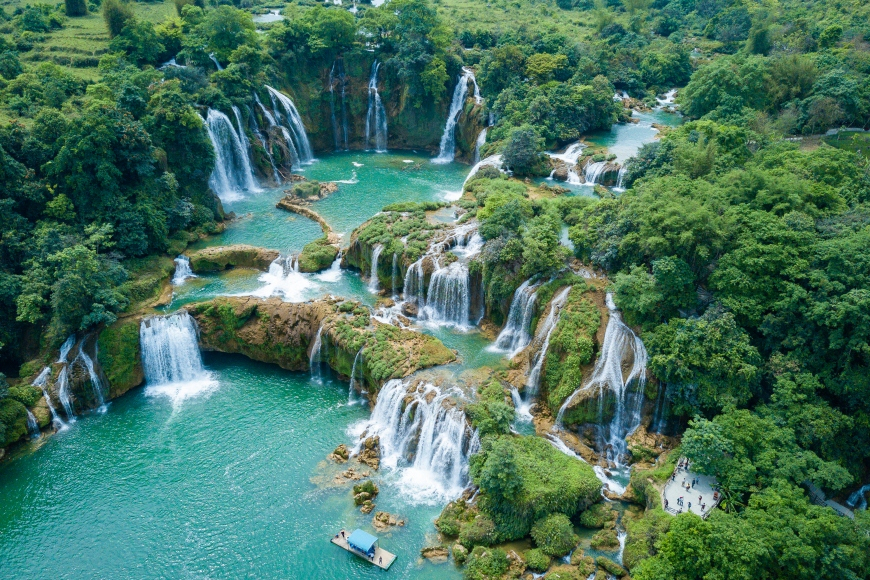
A classic, comprehensive loop that touches the major highlights—including the "Angel Eye" Mountain, the artisan villages of Quang Uyen, the thundering Ban Gioc Waterfall, and the remote borderlands of Ha Lang—typically covers between 300 and 350 kilometers (186 to 217 miles). This distance is usually spread over 5 to 6 days to allow for cultural immersion and recovery.
For those who want to experience the full diversity of the region, extending the journey to include the Pac Bo Historical Site or the serene waters of Ba Be National Park can push the total Cao Bang Loop cycling distance to 450 kilometers (280 miles) or more. This is the hallmark of our Vietnam Northeast Bike Tours, providing a seamless transition from karst towers to primary rainforests.
In the mountains of Northern Vietnam, horizontal kilometers on a map are deceptive. A 50-kilometer day in Cao Bang can feel like 100 kilometers on flat ground. Why? Because the "vertical distance"—the cumulative elevation gain—is where the real challenge lies. A standard loop involves climbing between 4,000 and 6,000 meters of total vertical gain. When assessing Cycling Northern Vietnam, you must calculate your pace based on the gradient, not just the odometer.
To help you visualize the effort required, let’s break down the loop into its iconic stages. These distances are based on the optimized routes we use for our Guaranteed Tours.
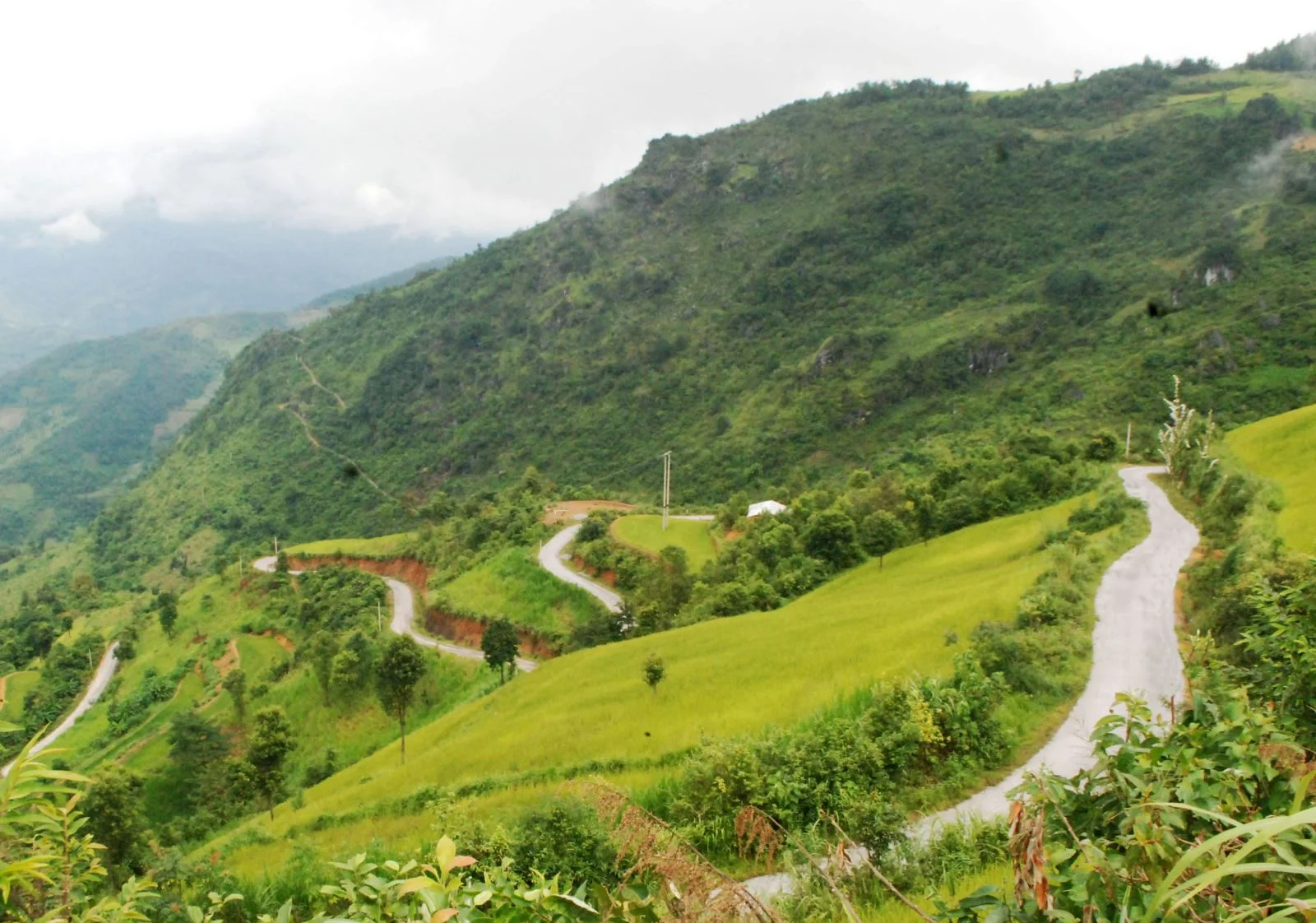
This is your "Introduction to the Karst." Leaving the provincial capital, the road winds through gentle undulations before the first major test: the Ma Phuc Pass.
Terrain: Mostly paved asphalt.
Vertical Gain: ~600m.
Challenge: The 7-tier hairpin turns of Ma Phuc.
Highlight: Arriving in the incense-making village of Phia Thap.
Today, the Cao Bang Loop cycling distance takes you deeper into the UNESCO Geopark.
Terrain: Mix of provincial roads and narrow village paths.
Vertical Gain: ~800m.
Highlight: Detouring to Nui Thung (Mountain Angel Eye). The sheer scale of the valley here makes the kilometers fly by.
A shorter distance day designed to allow for maximum photography and exploration.
Terrain: Mostly flat riverside roads along the Quay Son River.
Vertical Gain: ~300m.
Highlight: Standing at the base of the world's 4th largest border waterfall. This is the "soul" of our Cao Bang bike tours.
This is the "Wild Frontier" stage. While the distance isn't extreme, the isolation is.
Terrain: Rugged, remote mountain roads with occasional gravel.
Vertical Gain: ~1,100m.
Challenge: Several back-to-back passes with steeper gradients (8–12%).
The final push. This is a long day on the saddle, crossing the "Historical Heritage" route.
Terrain: Long, winding provincial highways.
Vertical Gain: ~900m.
Highlight: The descent back into the city as the sun sets over the limestone towers.
Cycling 60 kilometers a day for multiple days in a tropical mountain climate is a feat of endurance. Here is how to prepare for the Cao Bang Loop cycling distance.
We recommend a 12-week preparation phase. Start with 20km rides twice a week, gradually increasing to back-to-back 60km rides on weekends. The goal is to build "saddle time"—getting your body used to sitting on a bike for 5 to 7 hours a day.
Since the loop is rarely flat, horizontal training isn't enough. Find the steepest hill in your neighborhood and do repeats. Strength in your quadriceps and glutes is what will get you over the Ma Phuc Pass without having to push your bike.
The distance can be mentally taxing. In the remote stretches near Ha Lang, you might not see another tourist for hours. Building mental resilience and learning to find your "rhythm" is as important as physical strength.
Many riders ask us: "How does the distance compare to Ha Giang?" While both are epic, they offer different challenges.
|
Feature |
Cao Bang Loop |
Ha Giang Loop |
|---|---|---|
|
Total Distance |
300 - 350 km |
350 - 400 km |
|
Daily Average |
50 - 65 km |
60 - 80 km |
|
Max Gradient |
12% |
18% |
|
Traffic Level |
Low (Quiet) |
High (Motorbikes) |
|
Overall Difficulty |
Moderate to Challenging |
Extreme |
The Golden Verdict: If you are a dedicated cyclist who wants to focus on the ride rather than dodging thousands of motorbikes, the Cao Bang Loop is superior. It offers a more "sculptural" landscape and better road conditions for Cycling Northern Vietnam.
The wrong bike can make a 40km day feel like an 80km slog. To master the Cao Bang Loop cycling distance, your equipment must be optimized for efficiency and reliability.
For most riders, a high-quality Hardtail mountain bike (like the Trek or Giant models we use) is the ideal tool. It provides the efficiency needed for the long asphalt climbs while offering front suspension for the weathered concrete and gravel sections.
You need "granny gears." A 1x12 drivetrain with a 50T or 52T cog in the rear is a lifesaver. Being able to spin at a high cadence on a 10% gradient is the secret to covering long distances without burning out your legs by day three.
We recommend tires with a moderate tread—wide enough for grip on wet descents (2.1" - 2.25") but not so knobby that they create excessive drag on the smooth asphalt sections.
If the 350km Cao Bang Loop cycling distance isn't enough for you, we highly recommend the extension to Ba Be. This adds approximately 80 to 100 kilometers of riding through some of the most remote primary forests in the country.
Our Ba Be Lake bike tours are the perfect "cool down" after the jagged peaks of Cao Bang. The distance here is characterized by jungle canopies and serene lakeside paths. It is a transition from "Geology" to "Biology."
One of the biggest hurdles to covering the Cao Bang Loop cycling distance is luggage. Carrying 10kg of gear on your rack will slow you down by 20–30% and significantly increase your fatigue.
This is where our Guaranteed Tours provide a massive advantage.
The Van: Our support vehicle carries all your heavy bags. You ride with only a small daypack containing your camera and a rain shell.
The "Lift": If a mountain pass proves too much, or if a tropical downpour hits, you have the option to hop in the van and skip a few kilometers.
Hydration & Nutrition: The van is a mobile aid station. Frequent stops for cold water, electrolytes, and local fruits ensure your engine stays fueled for the long haul.
In the remote Northeast, a missed turn can add 20 unnecessary kilometers and 500 meters of climbing to your day.
We provide our riders with pre-loaded GPS tracks. Relying solely on Google Maps is risky; it often underestimates the difficulty of certain "shortcuts" that are actually impassable for bicycles.
No map can replace a local guide. Our English-speaking experts know exactly where the road is under construction and where the best "niche" trails are located. This expertise is what makes our Cao Bang bike tours the most efficient way to see the region.
To cover the Cao Bang Loop cycling distance, you will burn between 2,500 and 4,000 calories per day. You cannot do this on energy gels alone.
Breakfast: Banh Cuon Cao Bang (Rice rolls in bone broth). High in carbs and warm electrolytes.
Mid-Ride: Cao Bang Chestnuts and local bananas. Slow and fast-release sugars.
Dinner: Vit Quay (Roasted Duck) and local greens. Protein for muscle recovery and fiber for digestion.
Hydration: Aim for 4-6 liters of fluid per day. The humidity is a silent energy sapper.
Covering large distances in a UNESCO Geopark comes with responsibilities.
Buffalo Awareness: They are the "kings of the road." Give them space.
School Children: You will encounter hundreds of children walking or cycling to school. A wave and a "Hello" are the best ways to bridge the cultural distance.
Waste Management: Carry out what you carry in. The beauty of the Cao Bang frontier is its purity; let's keep it that way.
While some attempt a 3-day "Power Loop," we find that 5 days is the sweet spot for the Cao Bang Loop cycling distance.
Day 1-2: Finding your rhythm and adjusting to the heat.
Day 3: The "Magic Day" at the Waterfall (short distance, high reward).
Day 4: The "Queen Stage" (The hardest test).
Day 5: The "Victory Lap" back to the city.
This pacing ensures you return from your trip with memories of the scenery, not just memories of your front tire.
The Cao Bang Loop cycling distance is a challenge, a teacher, and a reward. It is a measure of your spirit as much as your fitness. As you pedal through the prehistoric valleys of the Northeast, the kilometers cease to be numbers and start to become stories.
At Golden Cycling Tours, we invite you to join us on this legendary path. From the thundering tiers of Ban Gioc to the silent artisan villages of the Nung, every kilometer is a masterpiece waiting to be discovered.
The frontier is open. Your bike is ready. Let’s ride.
On a standard 5-day tour, expect to cover between 50 and 65 kilometers per day. This allows for a moderate pace with plenty of stops for photos and cultural interaction.
We recommend the full loop for intermediate cyclists. However, for beginners, we can customize a "Support-Heavy" tour where the van assists on the steepest climbs, making the distance accessible to anyone with a basic level of fitness.
Yes. Certain sections of the route map near China require a border permit. When you book with Golden Cycling Tours, we handle all the administrative work and fees for you.
We recommend 29" or 27.5" tires with a width of 2.1 to 2.25 inches. A "semi-slick" or "all-terrain" tread pattern provides the best balance of speed on asphalt and grip on village paths.
Absolutely. We offer a 12-day "Grand Loop" that combines both regions. This is the ultimate test of endurance in Cycling Northern Vietnam.
"The Most Beautiful 300km of My Life" "I was worried about the distance, but the pacing of the Golden Cycling Tours itinerary was perfect. The support van was always there with cold water just when I needed it. Ban Gioc Waterfall is even more impressive when you've pedaled there yourself!" — David S., United Kingdom
"Distance Meets Culture" "The Cao Bang Loop isn't just about the kilometers; it's about the stops. We visited incense villages and blacksmiths that I never would have found on my own. The bikes were brand new and perfectly geared for the hills." *— Sarah M., Australia
"Better than Ha Giang for Pure Cycling" "I've done both loops now. Ha Giang is great for motorbikes, but for a pure cycling experience, Cao Bang is the winner. The roads are quieter, and the 'Angel Eye' mountain is a sight I'll never forget. Professional support made all the difference." — Markus T., Germany

.jpg "Vietnam Biking Vacation")
.jpg "Vietnam Biking Holiday")
.jpg "Cao Bang Cycling Vietnam")
Leave a Reply
Your email address will not be published. Required fields are marked *