- Call us Via Whatsapp: +84 (0) 832 126 699
4.9 stars on our site
(15,000 reviews)
- Monday - Sunday : 08:00 - 17:00
(15,000 reviews)

In the far northern frontier of Vietnam, where the clouds embrace jagged limestone peaks and the borders of reality seem to blur into ancient landscapes, lies the legendary "Happiness Road." For many, the Ha Giang Loop is a bucket-list item to be conquered by motorbike. However, for a growing community of elite adventurers, there is a more profound, visceral way to experience this frontier: by bicycle. But before you pack your bib shorts and clip-in shoes, one question must be answered with absolute honesty: What is the true Ha Giang Loop cycling difficulty?
At Golden Cycling Tours, we believe that some vistas are too beautiful to be rushed. Our professionally supported Ha Giang bike tours are designed to help you navigate this vertical world, providing the safety and logistical expertise required to turn a daunting challenge into a life-changing achievement. If you are ready to test your resilience against the most dramatic topography in Southeast Asia, this is your definitive guide to the ultimate Vietnam Northeast Bike Tours.
.jpg)
When we discuss the Ha Giang Loop cycling difficulty, we are looking at a terrain that ranks among the most demanding in the world for multi-day expeditions. This is not a casual ride through the countryside; it is a high-altitude odyssey that requires respect, preparation, and the right support.
The primary factor in the difficulty of the loop is the cumulative vertical gain. Over a standard 6-day circuit, a cyclist will encounter over 10,000 meters of total elevation gain. To put that in perspective, you are essentially climbing Mount Everest from sea level and then adding another 1,500 meters of climbing on top of that.
The gradients are relentless. While European alpine passes like the Stelvio or Mont Ventoux offer steady, predictable gradients of 7-8%, Ha Giang is unpredictable. You will frequently encounter "stingers"—short, brutal ramps reaching 15% to 18%—that require maximum power output and impeccable low-gear technique.
While the absolute altitude (averaging 1,000m to 1,500m above sea level) isn't high enough to cause acute altitude sickness for most, it is high enough to make your heart work significantly harder. The air is thinner than at sea level, and when combined with the humidity of Northern Vietnam, the "perceived exertion" on a 10% climb feels exponentially higher than a similar climb in a temperate climate.
A significant portion of the Ha Giang Loop cycling difficulty stems from the surface under your tires. The "Happiness Road" is a masterpiece of engineering, but it is a living road.
Much of the main loop is paved with relatively smooth tarmac. However, in a region prone to landslides and heavy seasonal rains, road conditions can change overnight. Cyclists must be prepared for gravel patches, loose stones on corners, and sections where the road has been washed away or is undergoing repair.
Descending in Ha Giang is a high-skill activity. The switchbacks are tight, and because the road is shared with local motorbikes and trucks, your line choice must be conservative. You need "hands-on-the-drops" confidence and a bicycle with flawless hydraulic disc brakes to manage the 10km-long descents safely.
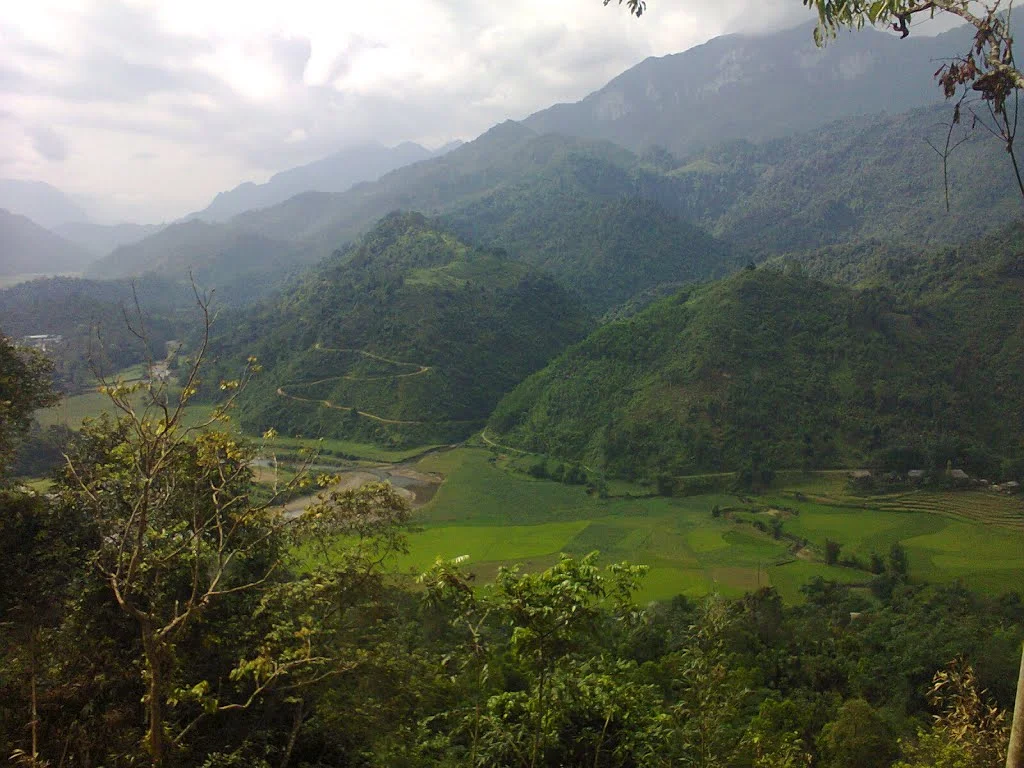
Built by hand between 1959 and 1965 by thousands of volunteers from 16 ethnic groups, the road was literally carved into the cliffs using hammers and crowbars. On a bicycle, you feel the texture of this history. The very architecture of the road—clinging to the sides of vertical limestone walls—contributes to the psychological difficulty. The exposure on passes like Ma Pi Leng can be dizzying; looking down 800 meters into the Nho Que River while balancing on two wheels is a mental test as much as a physical one.
To understand the Ha Giang Loop cycling difficulty, one must look at the specific milestones that define the journey.
Starting from Ha Giang City, the first major test is the Bac Sum Pass. This is a classic "zigzag" climb that rises sharply from the lowlands toward "Heaven’s Gate." It is often the first moment riders realize that the loop is not a game. The climb is sustained and offers no flat sections for recovery. It is a pure test of your aerobic base.
Located between Yen Minh and Dong Van, this pass is famous for its tight hairpins. For a cyclist, the difficulty here is the "rhythm break." Every time you hit a hairpin, your momentum drops, and you have to power out of the saddle to get the bike moving again. It is a muscular endurance test that leaves the legs heavy before you even reach the high plateau.
Widely considered the most beautiful road in Southeast Asia, it is also the most intimidating. The climb from Dong Van is long, but the real difficulty is the wind and the exposure. The road is carved into a vertical cliff, and the wind gusts can be significant. Managing your bike while taking in the staggering scale of the Tu San Canyon requires absolute focus.
Given the high Ha Giang Loop cycling difficulty, showing up without training is a recipe for struggle. Success requires a specific training protocol.
You will be in the saddle for 5 to 7 hours a day. Your body must be efficient at burning fat for fuel. We recommend a minimum of three months of consistent Zone 2 training (long, steady rides where you can hold a conversation) to build the mitochondrial density required for back-to-back mountain days.
You cannot simulate a 1,500m climb on a flat road. If you don't live near mountains, you must use "Big Gear" intervals on a trainer or find the steepest hill in your area and perform repeats. The goal is to get your legs used to pushing a high torque at a low cadence (60-70 RPM) for 40 to 60 minutes at a time.
When you are halfway up a pass in the mist, your legs are burning, and you can’t see the summit, your mind will tell you to stop. Mental resilience—the ability to sit with discomfort—is the secret weapon of the Ha Giang cyclist. At Golden Cycling Tours, our guides are not just navigators; they are motivators who understand the psychology of the climb.
Your gear can either mitigate or exacerbate the Ha Giang Loop cycling difficulty.
A standard "pro" setup with 53/39 chainrings and an 11-28 cassette will leave you walking. For Ha Giang, we recommend "Sub-Compact" or "Mountain Bike" gearing. A 1:1 gear ratio (e.g., a 34t chainring with a 34t or 36t rear cog) is the bare minimum. Many of our riders prefer a 1x12 setup with a 10-52t cassette to ensure they can keep their cadence high even on the 15% ramps.
The descents are as hard on the bike as the climbs are on the rider. Rim brakes are a liability in Ha Giang due to heat build-up on the rims and reduced performance in the frequent mountain mists. Hydraulic disc brakes are mandatory for our Ha Giang bike tours. They provide consistent, one-finger stopping power, allowing your hands and forearms to stay relaxed during the long drops.
We recommend 28mm to 32mm tires with good puncture protection. The extra volume allows for lower tire pressures, which increases traction on gravel patches and damp tarmac while providing much-needed vibration damping for your wrists and back.
The Ha Giang Loop cycling difficulty is compounded by the remoteness of the region. This is where professional support becomes essential.
At Golden Cycling Tours, every tour is accompanied by a professional support van. This vehicle is more than just a luggage carrier; it is your safety net. If you encounter a mechanical issue, our mechanics can fix it on the fly. If you hit your physical limit on a particularly brutal pass, you can hop in the van, recover with an electrolyte drink, and rejoin the group for the descent. Knowing that the "sag wagon" is behind you removes the psychological fear of "failing" a stage.
Our guides are the masters of the north. They know where the wind will be strongest, where the road is slippery, and where the best coffee stops are hidden. They set a pace that ensures the group finishes each day with enough energy to enjoy the cultural homestay experience. Without a guide, many independent cyclists blow up their legs on day one, making the rest of the trip a survival exercise rather than an adventure.
Ha Giang is a border province, and special permits are required for foreign travelers. We handle all the administration and permit procurement in advance. On a self-guided trip, the stress of navigating Vietnamese bureaucracy can add an unnecessary layer of difficulty to an already challenging trip. With us, your only job is to pedal.
If it were easy, it wouldn't be Ha Giang. The high Ha Giang Loop cycling difficulty is what preserves the region's authenticity.
Your effort earns you access to some of the most vibrant ethnic cultures on the planet. When you roll into Meo Vac on a Sunday morning, covered in road dust and sweat, you witness a sensory explosion of Hmong, Tay, and Lo Lo people trading livestock and textiles. You aren't just a tourist watching from a bus window; you are a fellow traveler who has shared the same mountain air.
The highlight of every evening is the "Family Dinner." Staying in traditional stilt houses and sharing a communal meal with a local family is the ultimate recovery for the mountain soul. The "Happy Water" (local corn wine) flows freely, and the stories shared around the table make every calorie burned on the pass worth it.
Difficulty and risk are related, but they are not the same. Managing the Ha Giang Loop cycling difficulty safely is our top priority.
Visibility: Mountain weather changes instantly. We provide high-visibility gear and ensure all riders use daytime running lights to remain visible to trucks and motorbikes in the mist.
Hydration and Nutrition: We provide professional-grade electrolyte hydration and high-calorie snacks. Dehydration is a major factor in "bonking" on mountain passes, which can lead to poor decision-making on descents.
Group Dynamics: We keep our groups small to ensure safety and a personalized experience. Our Vietnam Northeast Bike Tours are built on the camaraderie of the climb.
Is the Ha Giang Loop cycling difficulty suitable for beginners? No. We recommend this tour for intermediate to advanced cyclists who have experience with long climbs and technical descents. However, with our support van, we can accommodate various fitness levels as you can skip segments if needed.
What is the hardest day of the loop? Most riders find Day 4 (Dong Van to Meo Vac over Ma Pi Leng) the most visually stunning but Day 5 (Meo Vac to Du Gia) the most physically taxing due to the cumulative fatigue and the rugged, remote nature of the backroads.
Can I use a road bike or do I need a mountain bike? While the road is paved, we recommend a gravel bike or a mountain bike with slick tires. The easier gearing and more upright geometry are much better suited for the extreme gradients and occasional road construction than a traditional race bike.
What happens if I get a mechanical issue in the middle of a pass? This is why you book with Golden Cycling Tours. Our support vehicle carries spare parts, tools, and even spare bikes. Our mechanic will have you back on the road in minutes.
"I thought I was fit until I met the Bac Sum Pass. The Ha Giang Loop cycling difficulty is real, but so is the beauty. Having the support van from Golden Cycling Tours was a lifesaver. I couldn't have finished without the encouragement from our guides." — James T., Australia
"The most challenging 6 days of my life. Ma Pi Leng is a spiritual experience on a bike. If you want to see the real North Vietnam and test your limits, this is the only way to do it. The logistics were flawless." — Sarah L., USA
"A masterclass in mountain biking. The technical knowledge of the Golden team regarding gearing and pacing made a huge difference. Don't underestimate the climbs, but don't miss the views!" — Mark D., UK
The Ha Giang Loop is a journey that demands respect but gives back infinitely more in return. To stand at the top of a pass, your lungs burning and your heart racing, looking out over a sea of limestone clouds, is to know true freedom. It is a place that strips away the noise of modern life and replaces it with the raw beauty of the natural world and the warmth of its people.
Don't just see the frontier—conquer it. Explore our specialized Ha Giang bike tours and join the elite few who have pedaled through the clouds. For more inspiration on riding through Vietnam's remote reaches, check out our full range of Vietnam Northeast Bike Tours. The mountains are calling, and your adventure begins with a single pedal stroke.

.jpg "Cycling in Vietnam in March")
.jpg "Vietnam mountain bikes Trail")
.jpg "Vietnam Biking Trails")
.jpg "Ha Giang Cycling Tours")
Leave a Reply
Your email address will not be published. Required fields are marked *