- Call us Via Whatsapp: +84 (0) 832 126 699
4.9 stars on our site
(15,000 reviews)
- Monday - Sunday : 08:00 - 17:00
(15,000 reviews)

The northern frontier of Vietnam is a place where the earth rises in jagged waves and the roads cling to the sides of prehistoric cliffs. For the modern adventurer, the Ha Giang Loop is a siren song of verticality and cultural richness. While motorbikes have traditionally dominated these paths, a new era of elite travelers is seeking a deeper connection to the land through human power. To conquer this terrain, one needs more than just stamina; one needs a precise Ha Giang Loop cycling route map. This guide is designed to deconstruct the "Happiness Road" into manageable segments, providing the technical and logistical data required to navigate this UNESCO Global Geopark.
At Golden Cycling Tours, we specialize in transforming this formidable topography into a world-class adventure. Our professionally supported Ha Giang bike tours are backed by years of exploration and a deep understanding of the Northeast's rhythms. Whether you are a dedicated climber or a gravel enthusiast, this guide is your definitive resource for the ultimate Vietnam Northeast Bike Tours experience.
.jpg)
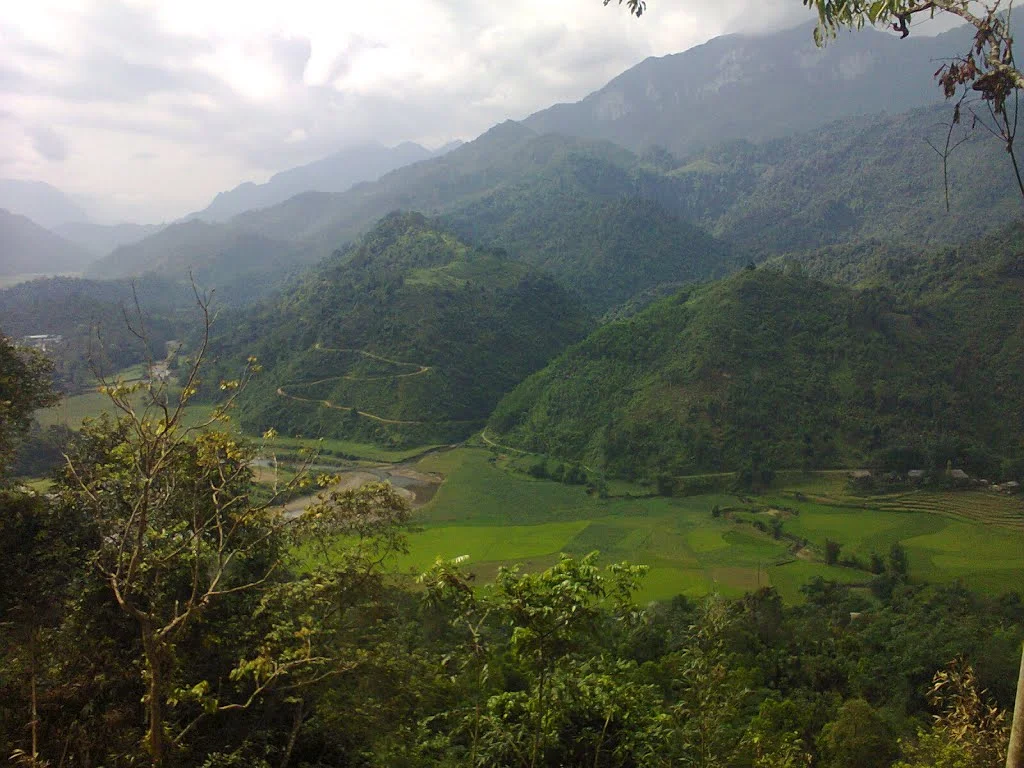
Before diving into the specific Ha Giang Loop cycling route map, it is essential to understand the geology of the Dong Van Karst Plateau. This is a "vertical desert"—a landscape of 2,300 square kilometers characterized by limestone pinnacles, deep canyons, and underground river systems. For a cyclist, this means a "sawtooth" elevation profile where every descent is immediately followed by a grueling ascent.
The route we follow is the legendary "Happiness Road" (Đường Hạnh Phúc). Built by hand between 1959 and 1965 by thousands of volunteers from 16 ethnic groups, the road was literally carved into the cliffs using hammers and crowbars. On a bicycle, you feel the texture of this history with every rotation of the pedals. You are riding on a monument to human resilience.
The full loop covers approximately 350 kilometers with a total vertical gain exceeding 10,000 meters. This is not a journey for the faint of heart. On a standard Ha Giang Loop cycling route map, you will notice that even short distances can take hours due to the sustained gradients, which frequently hover between 8% and 12%, with technical "stinger" sections reaching 15%.
To truly appreciate the region, we recommend a 6-day itinerary. This allows for recovery, photography, and cultural immersion. Here is the technical breakdown of the segments.
Distance: 50 km
Vertical Gain: 1,100 meters
Key Landmarks: Bac Sum Pass, Heaven’s Gate (Cổng Trời), Twin Mountains (Co Tien).
The journey begins at the 0km milestone. The first 25km are a gentle warm-up before you hit the Bac Sum Pass. This is your introduction to the "Dragon’s Back"—a series of winding hairpins that climb sharply. Reaching the Heaven’s Gate at the summit provides a panoramic view of the Tam Son valley. The final descent into Quan Ba requires confident technical handling, especially if the mountain mist rolls in.
Distance: 55 km
Vertical Gain: 950 meters
Key Landmarks: Can Ty Pass, Mien River, Yen Minh Pine Forest.
This stage on the Ha Giang Loop cycling route map transitions from lush greenery to starker karst formations. Following the Mien River provides a rare stretch of relatively flat road before you climb the Can Ty Pass. As you ascend, the air cools and you enter the Yen Minh Pine Forest—a Mediterranean-like landscape that offers a serene contrast to the jagged peaks.
Distance: 60 km
Vertical Gain: 1,400 meters
Key Landmarks: Nine-Ramp Pass (Doc Chin Khoanh), Sa Phin, Hmong King’s Palace.
This is arguably the most scenic day. You will traverse the Doc Chin Khoanh, a zigzagging masterpiece of engineering. The plateau here becomes a "rocky forest" where the Hmong people farm corn in the tiny pockets of soil between limestone rocks. Stopping at the Hmong King’s Palace provides a vital cultural pause before the final push into Dong Van town.
Distance: 30 km
Vertical Gain: 800 meters
Key Landmarks: Ma Pi Leng Pass, Tu San Canyon, Nho Que River.
Though the shortest day on the Ha Giang Loop cycling route map, it is the most emotionally and visually intense. The Ma Pi Leng Pass hangs 1,200 meters above the turquoise Nho Que River. For a cyclist, this 20km stretch is sacred ground. The road clings to the side of a vertical cliff, offering views into the deepest canyon in Southeast Asia. This is the "Queen Stage" of the north.
Distance: 75 km
Vertical Gain: 1,600 meters
Key Landmarks: Mau Due Valley, Lung Ho Pass, Du Gia Waterfall.
This is "Off the Beaten Track" cycling at its best. Leaving the main tourist corridor, the road to Du Gia is narrower and more rugged. The Mau Due valley features dramatic M-shaped peaks. The descent into the lush valley of Du Gia is the perfect reward, ending at a Tay ethnic village famous for its hospitality and waterfalls.
Distance: 80 km
Vertical Gain: 1,200 meters
Key Landmarks: Du Gia Pass, Thai An, Lo River.
The final day involves one last significant climb out of the Du Gia valley followed by a massive 20km descent back toward the lowlands. rolling back into Ha Giang City, you realize you haven't just followed a map—you've completed a rite of passage.
The Ha Giang Loop cycling route map is only as good as the bike you bring to it. You cannot "fake it" on these gradients.
Mountain Bikes (Hardtail): Our most popular choice for Ha Giang bike tours. The front suspension handles road construction and gravel patches, while the wide gearing is essential for 12% climbs.
Gravel Bikes: For the purist who wants speed on the tarmac. Ensure you have at least 40mm tires and a sub-compact or 1x drivetrain with a 42t or 50t rear cog.
Hydraulic disc brakes are a non-negotiable requirement. The descents are long—often 10km or more—and rim brakes will overheat and fade. We maintain our fleet to the highest standards because safety on the Happiness Road is paramount.
While the Ha Giang Loop cycling route map tracks the distance, the cultural map tracks the soul of the region. Ha Giang is home to 22 ethnic groups, including the Hmong, Tay, Dao, and Lo Lo.
Your journey should ideally intersect with a Sunday in Meo Vac or Dong Van. These markets are not tourist attractions; they are vital social hubs. You will see Hmong men trading cattle and Lo Lo women in vibrant traditional dress. As a cyclist, you arrive as a guest, sparking friendly interactions that motorbikers often zoom past.
The best way to experience the Northeast is in a traditional stilt house. Our Vietnam Northeast Bike Tours prioritize family-run homestays, ensuring your travel benefits the local community. Sharing a "Family Dinner" and a few cups of "Happy Water" (corn wine) is the ultimate recovery for the mountain soul.
Navigating the far north requires more than just a GPX file. It requires a support system that understands the technical and physical demands of the karst plateau.
Our guides are more than navigators; they are cultural ambassadors who speak local dialects and know every "secret" path. Every tour is accompanied by a professional support van—the "sag wagon"—which carries your luggage and provides a safe seat if a climb becomes too daunting.
Ha Giang is a border province, and special permits are required for all foreign travelers. We handle all the administration and permit procurement in advance, allowing you to focus purely on the pedal stroke. Our Ha Giang bike tours are turn-key adventures designed for maximum enjoyment.
The mountains are temperamental, and each season offers a different aesthetic on the Ha Giang Loop cycling route map.
September to October: The Golden Harvest. Terraced fields turn a shimmering yellow. Best for photography.
October to November: Buckwheat Season. Hillsides are blanketed in pink and purple flowers. Cool, dry air.
February to March: Spring Blossom. Plum and peach trees decorate the villages. Poetic mist creates an ethereal atmosphere.
May to August: Summer Challenge. Lush greenery and majestic waterfalls, though heat and rain make the climbs more grueling.
Is the Ha Giang Loop cycling route map suitable for intermediate riders? Yes, provided you have a good base level of fitness. Our support van ensures that if you hit your limit on a 15% gradient, you can hitch a ride to the summit and rejoin the group for the descent.
What kind of food should I expect? Local cuisine is fresh and organic. Expect plenty of mountain vegetables, free-range chicken, pork with ginger, and rice. We cater to vegetarian and vegan requirements with advance notice.
Do I need to bring my own bike? Many riders prefer the familiarity of their own machine, which we can help transport. However, we also provide high-end rentals (Trek, Giant) specifically maintained for the rigors of Northern Vietnam.
How do I handle navigation? While our guides lead the way, we provide all guests with updated GPX files for their bike computers, ensuring you always know where you are on the Ha Giang Loop cycling route map.
"The hardest thing I've ever done, but the most rewarding. Ma Pi Leng on a bike is a spiritual experience. The support from Golden Cycling Tours was flawless—I never had to worry about my gear or where I was going." — Mark S., United Kingdom
"A cycling tour is the only way to truly see the details of Ha Giang. Our guide knew every local family and the best places to eat. If you want a real adventure in Vietnam, this is it." — Elena R., Italy
"The logistics were perfect. Having the support van allowed me to enjoy the climbs without 15kg of luggage. The views of the Karst Plateau are simply world-class." — David W., Australia
The Ha Giang Loop is a journey that demands respect but gives back infinitely more in return. To stand at the top of Ma Pi Leng, your lungs burning and your heart racing, looking out over the Nho Que River, is to know true freedom. It is a place that strips away the noise of modern life and replaces it with the raw beauty of the natural world.
Don't just see the frontier—conquer it. Explore our specialized Ha Giang bike tours and join the elite few who have pedaled through the clouds. For more inspiration on riding through Vietnam's remote reaches, check out our full range of Vietnam Northeast Bike Tours. The mountains are calling, and your adventure begins with a single pedal stroke.

.jpg "Cycling in Vietnam in March")
.jpg "Vietnam mountain bikes Trail")
.jpg "Vietnam Biking Trails")
.jpg "Ha Giang Cycling Tours")
Leave a Reply
Your email address will not be published. Required fields are marked *