- Call us Via Whatsapp: +84 (0) 832 126 699
4.9 stars on our site
(15,000 reviews)
- Monday - Sunday : 08:00 - 17:00
(15,000 reviews)

In the world of adventure cycling, Northern Vietnam is often whispered about with a mix of reverence and awe. While the jagged, rocky plateaus of Ha Giang often take the spotlight, a quieter, more sculptural revolution is taking place further East. For the serious cyclist, understanding the Cao Bang Loop cycling elevation is the first step toward mastering one of the most geologically significant landscapes on the planet.
As a core part of the Non Nuoc Cao Bang UNESCO Global Geopark, this region offers a landscape that feels like a prehistoric ink painting brought to life. However, navigating this frontier on two wheels requires more than just a sense of wonder; it requires a deep understanding of the vertical gain, the gradients, and the logistical nodes of the mountains. At Golden Cycling Tours, we specialize in transforming these rugged heights into a manageable, life-changing journey. Whether you are considering our professional Cao Bang bike tours or planning a multi-day expedition, this guide is your definitive resource for understanding the "weight" of the ride.
.jpg)
When we talk about the difficulty of a cycling route, we often look at a few key metrics: total elevation gain, average gradient, and the frequency of "punchy" climbs. The Cao Bang Loop is unique. Unlike the sharp, vertical verticality of the Alps, Cao Bang offers a "Tower Karst" landscape. This means you aren't just climbing one massive mountain for four hours; you are navigating a series of undulating "waves" through the mountains.
On a standard 5-day circuit covering approximately 300 to 350 kilometers, the total cumulative Cao Bang Loop cycling elevation gain typically hovers between 4,500 and 5,500 meters. This makes it a moderate-to-challenging route. It is accessible for the fit weekend warrior, but it will humble the unprepared. In this section, we will break down the technical factors that define Cycling Northern Vietnam.
The karst towers are solitary limestone pillars that rise abruptly from flat, emerald valleys. For a cyclist, this means the route map often follows river valleys between these giants. While the valley floors are relatively level, moving from one valley to the next requires "pass-hopping." These passes—like Ma Phuc and Khau Lieu—are the milestones that define your journey.
Most provincial roads in the Northeast maintain a steady gradient of 6% to 8%. This is the "sweet spot" for rhythmic climbing. However, as we venture into "niche" village paths or border trails to avoid traffic, you will encounter spikes of 12% to 15%. Having a wide-range drivetrain is not just a luxury; it is a necessity for survival in these remote canyons.
To understand the elevation, you must understand the geology. Recognized by UNESCO in 2018, the Geopark covers over 3,000 square kilometers. It is a "land of fossils" and geological marvels dating back 500 million years. For a cyclist, this geography is your greatest adversary and your greatest reward.
The loop follows major river systems like the Bang River and the Quay Son River. These waterways have carved deep canyons. Descending into these canyons is exhilarating, providing fast, sweeping corners, but it also sets the stage for the next climb. The humidity trapped in these river valleys can also add a "perceived difficulty" to the climbs, as the air feels heavier and thicker than on the clear ridges of ha-giang-bike-tours.
If you decide to extend your journey westward, you will encounter the Phia Oac - Phia Den National Park. This is where the Cao Bang Loop cycling elevation hits its peak. Climbs here take you into high-altitude primary forests where the biodiversity and climate shift dramatically. This route often serves as the gateway for those continuing on Ba Be Lake bike tours.
To help you prepare, we’ve broken down a typical 5-day high-impact itinerary based on our professional Vietnam Northeast Bike Tours.
Elevation Gain: ~750m.
Max Altitude: 620m.
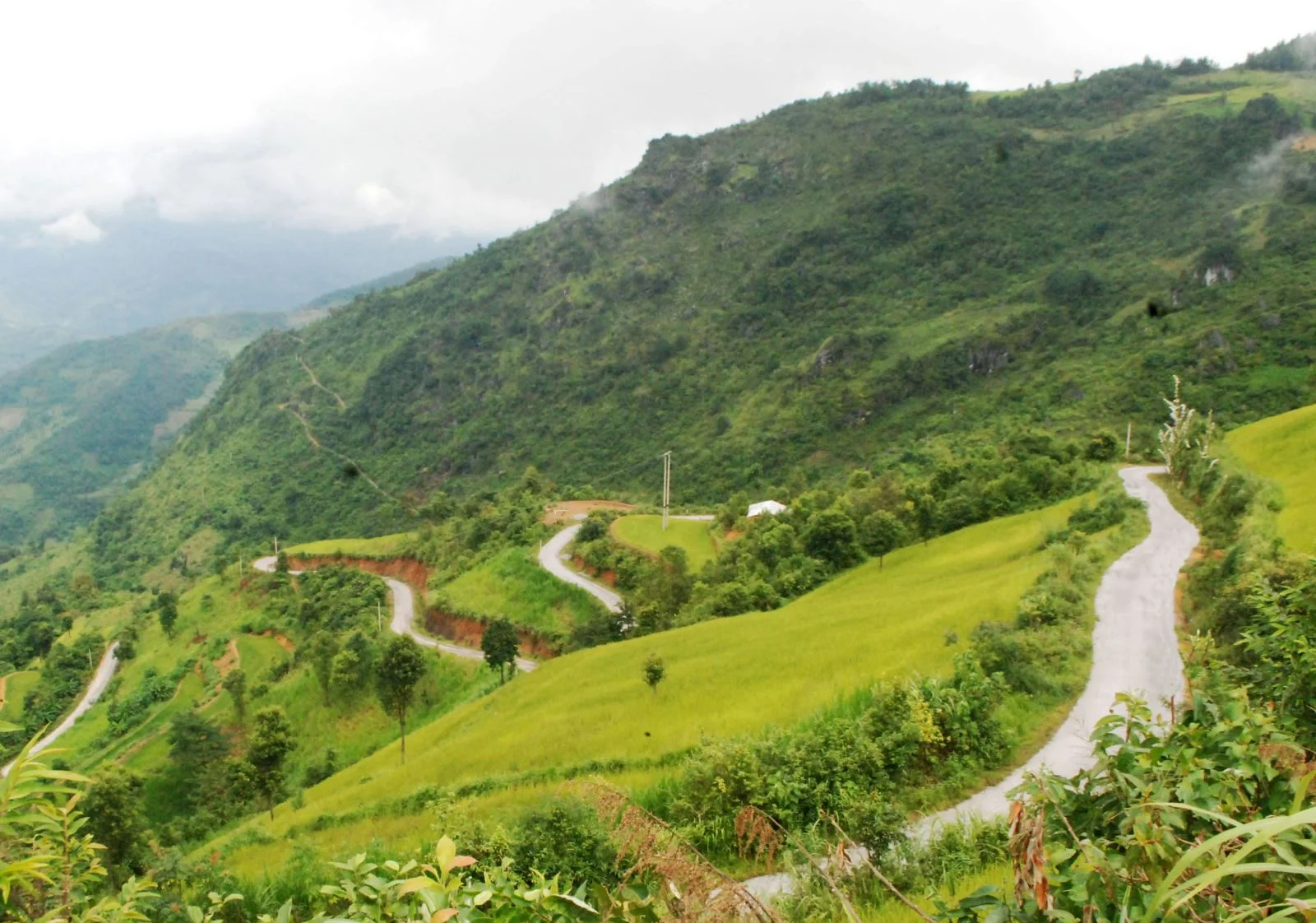
Challenge: Ma Phuc Pass (Horse Kneeling Pass). This is your first major test. The pass features seven tiers of hairpin turns. While the asphalt is smooth, the psychological weight of the first major climb is real.
The Reward: A long, winding descent into the incense-making village of Phia Thap.
Elevation Gain: ~850m.
Terrain: Undulating "humps" rather than long passes.
Challenge: Don't let the distance fool you. The constant "roller-coaster" terrain can be more fatiguing than a single long pass.
The Reward: Riding alongside the turquoise Quay Son River, where giant bamboo waterwheels turn slowly in the current.
Elevation Gain: ~400m.
Terrain: Mostly flat riverside roads.
Challenge: This is a recovery day in terms of Cao Bang Loop cycling elevation. The difficulty lies in the technicality of "niche" border trails if you choose to explore the hidden markers.
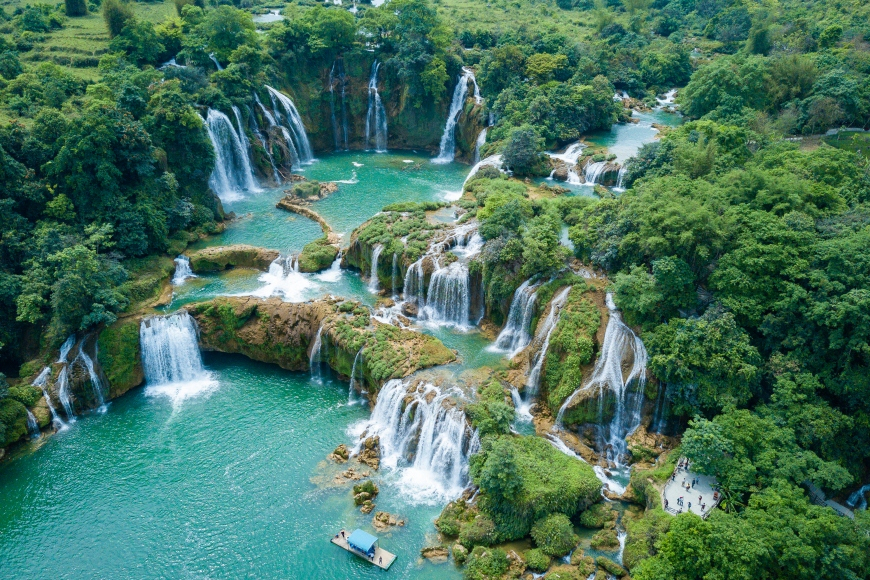
The Reward: Standing at the base of the world's 4th largest border waterfall. This is the "soul" of our Cao Bang bike tours.
Elevation Gain: ~1,300m.
Terrain: Rugged, remote mountain passes.
Challenge: Khau Lieu Pass. This is a technical climb with several steep ramps. Ha Lang is the most remote district in the province, and the isolation adds to the perceived difficulty.
The Reward: Some of the most pristine, untouched karst scenery in all of Southeast Asia.
Elevation Gain: ~950m.
Terrain: Long, winding provincial roads.
Challenge: Cumulative fatigue. By Day 5, your legs will feel every meter of gain.
The Reward: A final exhilarating descent back into the city for a celebratory dinner of roasted duck.
Conquering the Cao Bang Loop cycling elevation requires a professional approach to equipment. At Golden Cycling Tours, we curate our fleet and our guaranteed tours specifically for this terrain.
You need "granny gears." We recommend a drivetrain with a 1:1 gear ratio (or better). For example, a 32T chainring in the front and a 50T or 51T cog in the rear. Being able to maintain a cadence of 75-85 RPM on a 7% gradient is the secret to finishing a 5-day tour with a smile rather than a grimace.
Hydraulic disc brakes are non-negotiable. The long mountain descents (some lasting 10-15km) can cause rim brakes to overheat. Disc brakes provide the one-finger modulation needed for technical corners, especially if you encounter a sudden tropical rain shower.
We recommend tires with a width of 2.1" to 2.3". While the roads are mostly paved, the extra volume provides crucial comfort over weathered concrete and better grip on the occasional gravel shortcut.
A common question from our guests is: "Is it harder than the Ha Giang Loop?" While we offer world-class ha-giang-bike-tours, the vertical profiles are distinct.
Gradients: Ha Giang features more "walls" (15-20% ramps), while Cao Bang's passes are generally more steady (6-10%).
Cumulative Gain: Ha Giang typically involves more daily vertical gain (~1,500m per day), whereas Cao Bang averages around 900m to 1,100m.
Traffic Noise: Cao Bang has roughly 70% less traffic. For many, the "difficulty" of dodging motorbikes in Ha Giang makes the ride feel harder than it is. In Cao Bang, you have the silence to focus on your breathing.
We believe that the sweat is the price of admission to a world that hasn't changed in centuries. The Cao Bang Loop cycling elevation is offset by the profound cultural rewards found at the summits.
In districts like Quang Uyen, the villages are hidden in high valleys. To reach the famous incense-making village of Phia Thap, you must climb. Once there, you see thousands of incense sticks drying in the sun—a visual reward that a car could never appreciate.
The river valleys are home to the Tay people. Their hydraulic engineering (waterwheels) is a testament to their master of the environment. Stopping by these wheels after a long climb provides a sense of peace that is the foundation of our Vietnam Northeast Bike Tours.
If the thought of navigating the Cao Bang Loop cycling elevation alone is daunting, that’s where Golden Cycling Tours comes in. Our guaranteed tours provide a "safety net" that allows you to focus on the joy of the ride.
The Support Van: Our "sweeper" van follows at a distance. If a hill is too steep or your legs give out, you can hop in the van for a lift to the summit. It also carries your heavy luggage, leaving you with just a light daypack.
Professional Mechanics: We handle all punctures and derailleur adjustments on the fly, ensuring you don't waste energy on bike repairs.
Nutrition and Hydration: Our team provides frequent stops for cold water, electrolytes, and local fruits like Cao Bang chestnuts to keep your engine fueled.
For those who find the 300km circuit not challenging enough, we recommend extending the route. The transition from Cao Bang to Ba Be involves a 75km stage with significant elevation gain through primary rainforests.
Our Ba Be Lake bike tours offer a serene "cool down" after the jagged peaks. The terrain shifts from "Geology" (limestone towers) to "Biology" (lush jungles and freshwater lake systems). It is the perfect conclusion to a journey through Cycling Northern Vietnam.
Mastering the elevation also means respecting the road.
Descending Protocol: Always stay on the right side of the road. In the mountains, local motorbikes and buffalo can appear around any corner.
Hydration Strategy: Humidity is a silent energy sapper. Aim for 4-6 liters of fluid per day.
Leave No Trace: Cao Bang is a UNESCO Geopark. We carry out all our trash and respect the local traditions of the Nung and Tay people.
The Cao Bang Loop cycling elevation is a challenge, a teacher, and a reward. It is a measure of your spirit as much as your fitness. As you pedal through the prehistoric valleys of the Northeast, the vertical meters cease to be numbers and start to become memories.
At Golden Cycling Tours, we invite you to join us on this legendary path. From the thundering tiers of Ban Gioc to the silent artisan villages of the Nung, every meter of gain is a masterpiece waiting to be discovered.
The frontier is open. Your bike is ready. Let’s ride.
No. While there are daily climbs, the gradients are steady. With a good level of base fitness and our support vehicle, intermediate riders can comfortably enjoy the loop.
We recommend a drivetrain that allows for a 1:1 ratio or better (e.g., 30T front chainring and 34T or higher rear cog). This allows you to "spin" up the passes.
No. The highest points on the loop are generally under 1,000 meters. You will feel the humidity, but you will not experience oxygen deprivation.
Our guaranteed tours include a support van. If a climb is too much, you can simply hop in the van and resume riding at the summit.
On a standard tour, you can expect between 800m and 1,200m of cumulative vertical gain per day.
"Elevation Meets Inspiration" "I was worried about the hills, but the Cao Bang Loop is so beautiful that you almost forget your legs are burning. The Ma Phuc Pass was the highlight—the descent was like flying! Golden Cycling Tours made everything easy with their support van." — David S., United Kingdom
"Perfect Pacing" "The way the Golden Cycling Tours team plans the itinerary is perfect. They balance the hard climbing days with recovery sections. I've done Ha Giang too, and I found Cao Bang to be much more 'zen' and less stressful." — Sarah M., Australia
"Expert Support in the Remote Northeast" "If you're going to tackle these mountains, go with the pros. The bikes were perfectly maintained and the gear ratios were spot on for the gradients. The local duck noodles at the end of a 1,000m day were the best food I've ever had!" — Markus T., Germany

.jpg "Vietnam Biking Vacation")
.jpg "Vietnam Biking Holiday")
.jpg "Cao Bang Cycling Vietnam")
Leave a Reply
Your email address will not be published. Required fields are marked *