- Call us Via Whatsapp: +84 (0) 832 126 699
4.9 stars on our site
(15,000 reviews)
- Monday - Sunday : 08:00 - 17:00
(15,000 reviews)

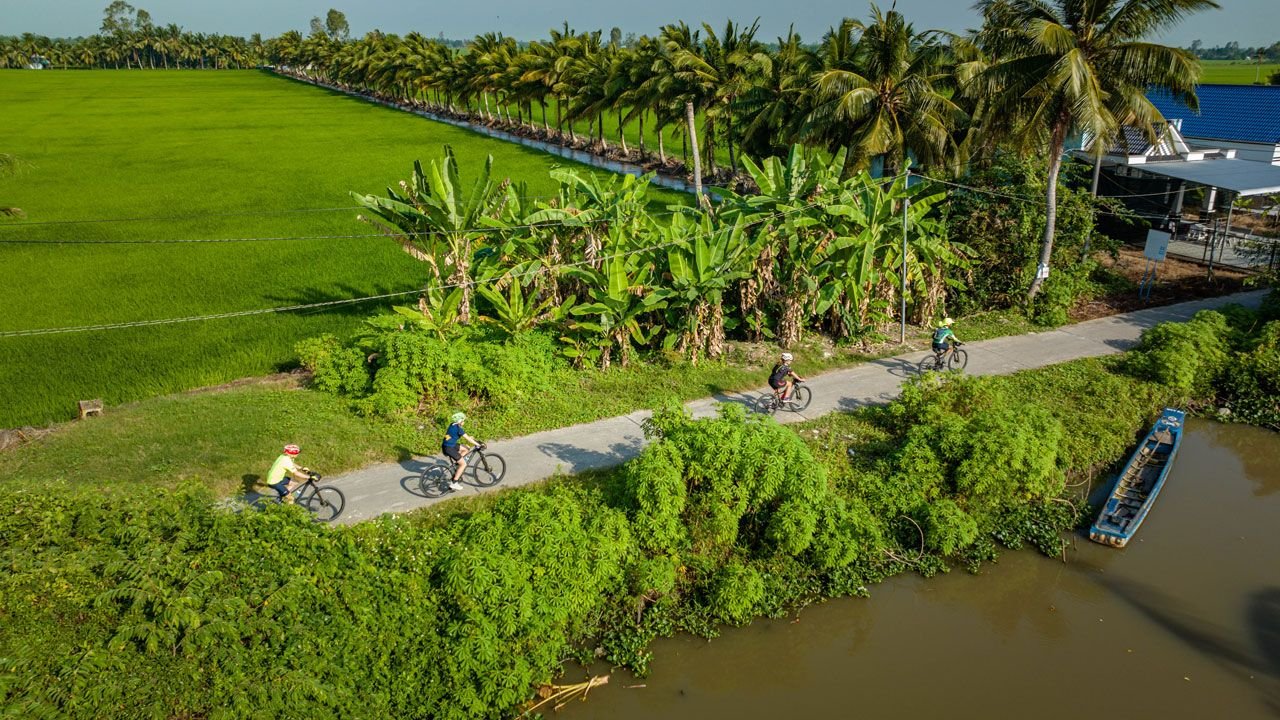
The modern travel landscape is shifting away from crowded tourist hotspots and superficial sightseeing. Today’s conscious travelers seek connection, depth, and genuine transformation. They want to swap major highways for single-track dirt lanes, skyscrapers for bamboo forests, and giant luxury hotels for the warmth of family-run stilt houses. There is no better way to answer this call than by immersing yourself in Authentic Village E-Bike Experiences Vietnam, a mindful journey that places you directly in the heart of rural communes, untouched nature reserves, and ancient ethnic minority settlements.
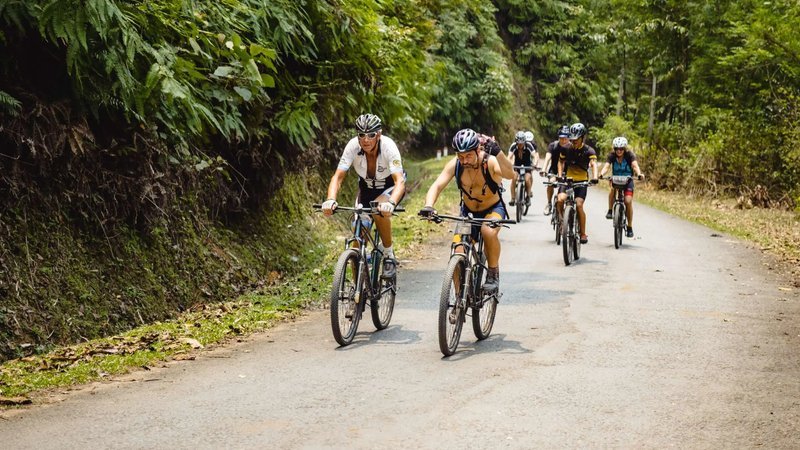
Vietnam is a country with an incredibly rich rural tapestry. More than sixty percent of its population resides in villages, each maintaining ancient customs, distinct culinary traditions, and unique architecture. However, navigating these steep mountain trails, narrow river dikes, and remote mountain passes can be challenging on foot or exhausting on a standard bicycle. The modern electric mountain bike (e-bike) acts as the perfect vehicle for this kind of travel. Combining gentle human pedaling with a quiet, zero-emission electric motor, e-bikes allow you to traverse remote terrain easily, scale steep mountain loops, and wind through ancient villages without the noise or pollution of motor vehicles.
.jpg)
To help you design the ultimate travel plan, Golden Cycling Tours provides custom-crafted active vacations that bridge the gap between premium physical exploration and deep cultural respect. Their professional Vietnam e-bikes tours pair state-of-the-art electric bicycles with expertly guided rural itineraries, ensuring that your journey through Vietnam’s majestic villages is sustainable, deeply personal, and highly memorable.
Traveling through rural Vietnam is an art form. While typical tourist coaches run on rigid schedules along major expressways, they isolate travelers from the actual landscape. Motorbikes offer speed but come with noise, exhaust fumes, and a rapid pace that makes slow, mindful observation impossible. The electric bicycle is the ultimate alternative.
On an e-bike, there are no glass windows separating you from the environment. You hear the clear morning call of forest birds, smell the sweet aroma of wild cardamom growing on mountain ridges, feel the sudden cool drop in temperature as you enter a shaded bamboo grove, and hear the gentle splash of rivers feeding the rice fields. It transforms travel from a passive visual display into a full-sensory, active engagement with the natural world.
One of the greatest benefits of modern electric mountain bikes is that they democratize active adventure.
Customizable Assistance: You control the level of motor support. If you want a healthy cardio workout on flat valley dirt paths, you can ride on low assistance. If you encounter a steep vertical trail leading to a high-elevation village, you can increase the assist level to glide upward smoothly.
Leveling the Playing Field: E-bikes allow couples, families, and multi-generational travel groups of varying physical fitness levels to ride together at the same pace. Nobody is left behind, and nobody is physically exhausted at the end of the day.
Preserving Fragile Ecosystems: E-bikes run on clean, rechargeable lithium batteries. They emit no greenhouse gases, create zero noise pollution, and leave the pristine mountain air and peaceful village environments completely undisturbed for the communities that host us.
Vietnam’s vast geography offers an array of village ecosystems, from the ancient craft communities of the Red River Delta to the mist-shrouded mountain outposts of the far north. Here is your ultimate guide to the best locations for village e-bike exploration.
Just beyond the bustling streets of Vietnam’s historic capital lies a world of tranquil river dikes, ancient brick alleys, and multi-generational artisan communities. Here, centuries-old traditions continue to shape daily life.
An ideal village route begins by crossing the historic Long Bien Bridge and heading along the dikes of the Red River. You will ride through lush banana plantations and flower fields to reach Bat Trang, a world-famous pottery village where artisans have shaped clay since the 14th century. Alternatively, you can head west toward Duong Lam Ancient Village, a living museum of late-feudal Northern Vietnamese architecture, featuring houses built of local red laterite stone and ancient communal temples.
Tasting traditional hot green tea with village elders in Duong Lam inside a courtyard filled with fermenting soy sauce jars. Navigating these narrow brick alleys is remarkably peaceful on an electric bike, allowing you to stop easily for photographs and converse with local craftspeople. Discover these historic suburban lanes on specialized, small-group Hanoi bike tours.
Located south of Hanoi, Ninh Binh is famous for its dramatic limestone karst mountains that rise abruptly out of flat emerald rice fields, earning it the title of "Halong Bay on Land."
The paths in Ninh Binh are pleasantly flat, winding along quiet rivers, lotus marshes, and historic sites. You will ride through rural hamlets around the Trang An Scenic Landscape Complex and head into ancient villages like Van Long and Thung Nham. You will pedal along stone paths bordered by towering karst cliffs, passing local farmers tending to water buffaloes in the wetlands.
Riding along the edge of the wetlands at sunset, watching thousands of white storks return to their nests in the limestone cliffs. Because the terrain is very flat, you can enjoy a leisurely, contemplative ride that combines perfectly with a traditional wooden rowboat journey through karst caves. Experience this poetic landscape with curated Ninh Binh bike tours.
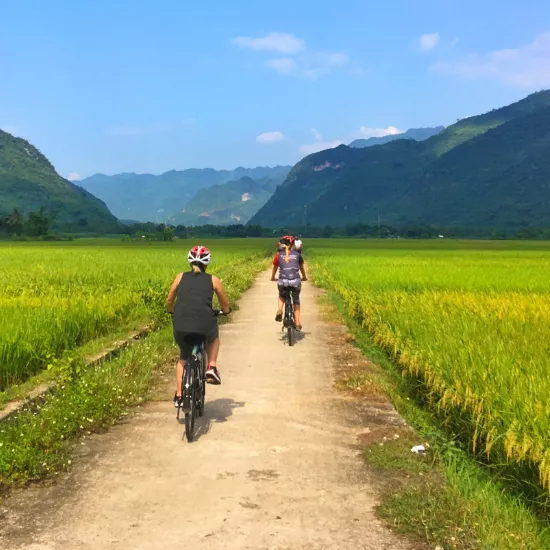
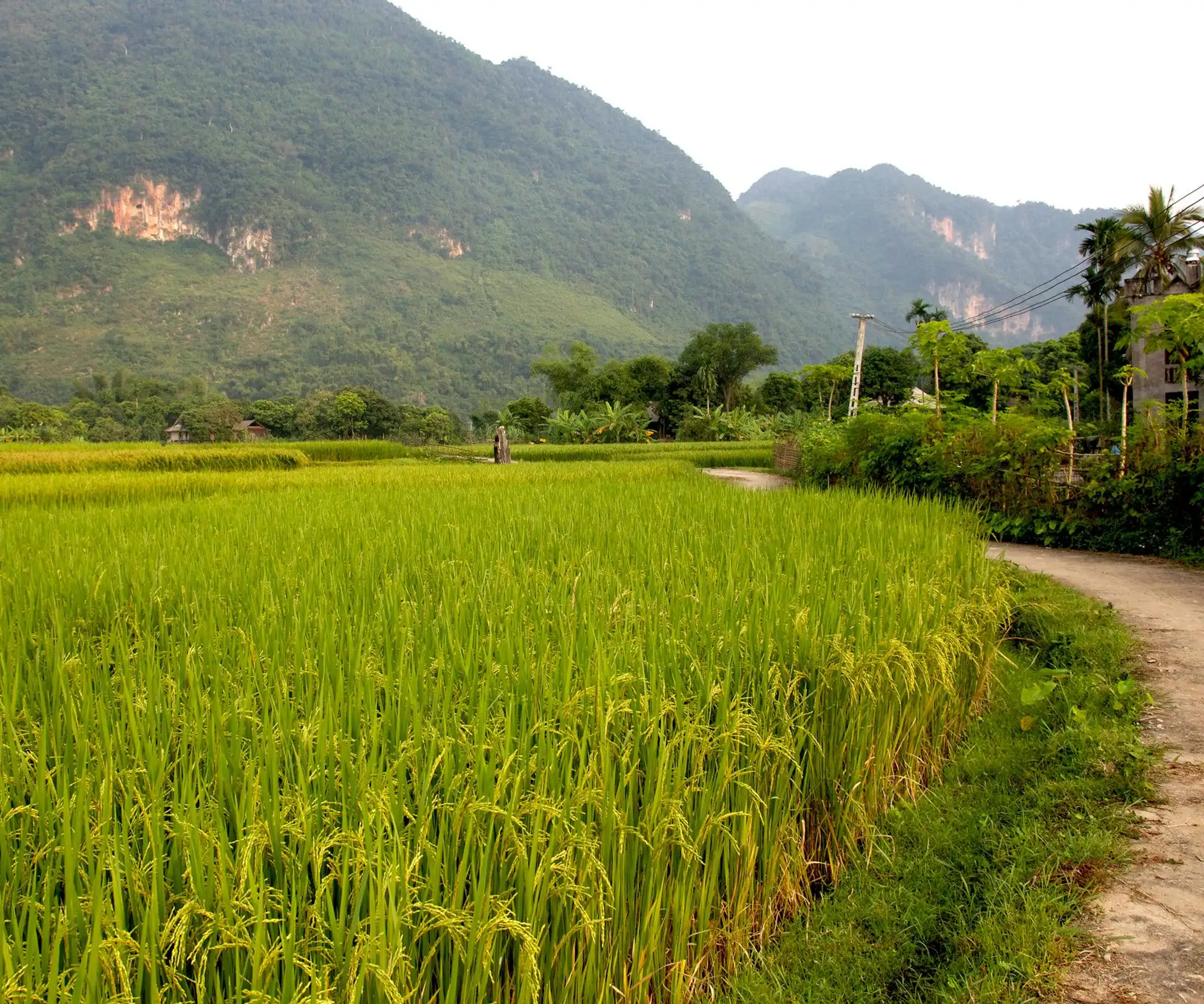
Nestled in Hoa Binh Province, Mai Chau is a flat, fertile green valley surrounded by a dramatic circle of towering green hills, offering a peaceful sanctuary from urban life.
The valley floor is a network of small paved roads and narrow dirt tracks that weave through beautiful White Thai villages, including Lac Village, Pom Coong, Sam Khoe, and Na Phon. The local houses are built on tall, sturdy wooden stilts, creating a beautiful architectural style that has been preserved for generations.
Listening to the rhythmic clack-clack of traditional wooden handlooms as local Thai women weave colorful silk textiles beneath their stilt houses. The flat terrain makes Mai Chau incredibly accessible, allowing you to ride easily from one village to another, stopping to chat with local weavers or enjoy a cold drink by the rice paddies. Start your peaceful valley escape with Mai Chau bike tours.
Adjacent to Mai Chau, Pu Luong is an incredibly biodiverse reserve characterized by steep mountain slopes, deep river valleys, and spectacular terraced rice fields.
The terrain in Pu Luong is more rugged and challenging. Your e-bike will navigate dirt single-tracks, rocky paths, and steep climbs to reach remote hamlets like Kho Muong Village, Don Village, and Uoi Village, which are beautifully nestled on mountain slopes.
Encountering the massive, hand-built bamboo waterwheels of the Cham River. These structures channel water from the river up into elevated rice paddies using simple, sustainable engineering. The pedal-assist motor on your e-bike is invaluable here, helping you climb high mountain passes with ease while keeping your focus on the sweeping terraced views. Book your natural escape with specialized Pu Luong bike tours.
Sapa is famous worldwide for its dramatic landscapes, terraced valleys, and the towering Hoang Lien Son mountain range.
While traditional cycling in Sapa is physically demanding due to the steep climbs, e-bikes make this epic terrain highly accessible. You will ride down from Sapa town into the spectacular Muong Hoa Valley, passing through villages of different ethnic groups, including the Black Hmong in Lao Chai, the Red Dao in Ta Van, and the Tay people in Ban Ho.
Riding along high mountain ridges through patches of cool mountain mist, looking down over miles of golden terraced fields during the autumn harvest season. The e-bike makes the steep climb back up to Sapa town comfortable and enjoyable, ensuring you can appreciate the scale of this dramatic landscape. Explore Sapa's high-altitude paths with Sapa bike tours.
Tucked away in northeastern Vietnam, Cao Bang is home to the Non Nuoc Cao Bang UNESCO Global Geopark, featuring a wild, pristine landscape of limestone forests and ancient minority communities.
You will pedal along quiet border roads through karst valleys to reach historic villages like Phuc Sen, a traditional blacksmithing village of the Nung An people, and Khuoi Ky, an ancient Tay village famous for its unique stone stilt houses. The trails lead you along winding rivers to the spectacular Ban Gioc Waterfall on the border with China.
Riding along the historic stone paths of Khuoi Ky Village, where every home is constructed of hand-carved river stones, representing a deep connection to the earth. The peaceful roads of Cao Bang offer a quiet, remote cycling experience. Plan your far-north journey with Cao Bang bike tours.
Ha Giang is Vietnam’s final frontier. It is home to the spectacular Dong Van Karst Plateau Geopark and offers some of the most dramatic mountain scenery on earth.
The roads of Ha Giang are carved into the sides of towering limestone mountains. The climbs are exceptionally steep, and the descents are legendary. Your e-bike ride will take you through remote villages like Lung Cam in the scenic Sung La Valley, and down to the Nho Que River canyon below the famous Ma Pi Leng Pass.
Standing at the peak of the Ma Pi Leng Pass, looking down over the emerald waters of the Nho Que River flowing through a 1000-meter-deep canyon. The electric bicycle provides the necessary torque to conquer these famous mountain roads comfortably, making it a bucket-list experience for active travelers. Embark on the ultimate loop with Ha Giang bike tours.
For travelers who wish to extend their journey and connect multiple village destinations into a single, seamless exploration, Golden Cycling Tours offers grand regional loops:
The Northwest Route: Explore deep valleys, high mountain passes, and vibrant minority markets with Vietnam Northwest bike tours.
The Northeast Route: Navigate pristine karst geoparks, quiet border roads, and majestic waterfalls with Vietnam Northeast bike tours.
Comprehensive Northern Explorer: To enjoy the absolute best of Northern Vietnam’s landscapes in a single, deeply immersive itinerary, consider cycling Northern Vietnam.
Luxury Eco-Travel: For travelers who want to combine physical adventure with exceptional comfort, premium boutique ecolodges, top-of-the-line e-bikes, and private support vehicles, choose vietnam luxury bike tours.
The Historical Trail: Retrace Vietnam's historic routes, pedaling through military history, deep jungles, and national parks with ho chi minh trail cycling tours.
The Grand Trans-Vietnam: For the ultimate lifetime achievement, ride from the historic capital of Hanoi all the way to the southern metropolis of Ho Chi Minh City on an epic route for cycling North to South Vietnam.
Northern Vietnam is home to a rich tapestry of ethnic minority groups, including the Hmong, Dao, Tay, Thai, Nung, and Giay. Each community maintains its own unique language, traditional attire, and beliefs. Slow travel is about being a respectful and welcome guest in their ancestral homes.
Dress Modestly: When entering local homes, communal buildings, or temples, ensure your shoulders and knees are covered.
Ask Before Taking Photos: A warm smile and a polite gesture to ask for permission before taking a photo goes a long way. Respect the privacy of local people.
Do Not Give Handouts to Children: Giving money, candy, or small gifts directly to children encourages begging and can discourage them from attending school. If you wish to support a community, ask your Golden Cycling Tours guide how to make a formal donation to local schools or community centers.
Stilt Houses: Popular among the Tay, Thai, and Muong people in regions like Mai Chau and Pu Luong. These homes are elevated on thick wooden pillars, protecting the family from dampness, floods, and animals, while the ground floor is traditionally used for weaving or storage.
Earthen Houses (Trinh Tuong): Found in the cold, windy mountain regions of Ha Giang and Cao Bang. These homes are constructed with thick, hand-rammed earth walls that keep the interiors warm in winter and cool in summer.
Food is a cornerstone of the slow travel philosophy. Vietnamese cuisine is famous for its fresh, balanced, and healthy profiles, utilizing local herbs, spices, and fresh meats.
What to Eat: Pho Bo (traditional beef noodle soup), Bun Cha (grilled pork belly and meatballs in a warm broth served with rice noodles), and Ca Phe Trung (rich, sweet egg coffee).
Where to Eat: Savor street-side stalls in the historic Old Quarter or cozy boutique cafes overlooking the Hoan Kiem Lake.
What to Eat: Com Chay (crispy, sun-dried puffed rice topped with savory pork floss) and De Nui (mountain-grazed goat meat, which is exceptionally lean and tender, typically served with local herbs and sesame seeds).
Where to Eat: Family-run restaurants located near the entrance of Tam Coc or Trang An.
What to Eat: Com Lam (fragrant sticky rice roasted inside bamboo tubes), Ga Doi (free-range hill chicken), and fresh river fish grilled with wild mountain spices like Mac Khen (local forest pepper).
Where to Eat: Share an authentic, home-cooked family meal prepared by your local hosts at your village homestay.
What to Eat: Thang Co (traditional Hmong soup made of horse meat and local spices), Lau Ca Hoi (fresh mountain salmon hotpot, perfect for Sapa's cool mountain evenings), and Men Men (steamed ground corn, a traditional Hmong staple).
Where to Eat: Cozy rustic restaurants in Sapa town or traditional markets in Dong Van and Meo Vac.
A good night's rest is vital after an active day on the road. Slow travel encourages staying in accommodations that support the local economy and protect the environment.
The Experience: Sleep in a beautifully preserved Thai stilt house in Mai Chau or a Tay wooden home in Cao Bang. Guests typically sleep on comfortable mattresses laid out on a communal wooden floor, protected by mosquito nets.
Why It’s Sustainable: Homestays channel tourist dollars directly into the hands of local families, preserving traditional architecture and fostering authentic cross-cultural exchange.
Key Locations: Lac Village (Mai Chau), Ban Ho Village (Sapa), and Pac Ngoi Village (Ba Be National Park).
The Experience: For those who prefer private bathrooms, swimming pools, and high-end comfort, boutique eco-lodges are built directly into mountain cliffs and terraced hillsides. These lodges prioritize local materials, waste reduction, water conservation, and renewable energy.
Why It’s Sustainable: They balance luxury with high environmental stewardship, hiring local staff and sourcing food from nearby organic gardens.
Key Locations: Pu Luong Retreat, Topas Ecolodge (Sapa), and Avana Retreat (Mai Chau).
When you book a guided tour with Golden Cycling Tours, all internal regional transfers are organized for you. If you are exploring how logistics work, here are the most common sustainable transport methods in Vietnam:
The Standard: Most guided e-bike tours include a dedicated private support van or minibus. It carries your heavy luggage, provides cold water and fresh fruit, and is always available if you want to take a break from riding.
Comfort and Convenience: Spacious, multi-passenger Dcar Limousine vans operate regularly between Hanoi and major travel hubs like Sapa, Mai Chau, and Ninh Binh. They feature plush leather seats, air conditioning, and USB chargers.
An Eco-Friendly Classic: Taking the overnight sleeper train from Hanoi to Lao Cai (the gateway to Sapa) is a highly romantic and environmentally friendly way to travel, allowing you to sleep comfortably through the journey and arrive refreshed in the morning.
Here is what travelers have to say about their slow-travel e-bike journeys:
"The e-bikes provided by Golden Cycling Tours completely changed my travel perspective! I was worried about my fitness level on the steep trails of Sapa and Pu Luong, but the electric motor made the climbs smooth and enjoyable. We rode directly into small, mist-shrouded villages, shared tea with local families, and stayed in beautiful wooden homestays. It felt like a true journey of connection rather than a typical sightseeing trip." — Sophia K., Canada
"Cycling through Ninh Binh and Mai Chau on an electric bike was the absolute highlight of our trip to Vietnam. Being able to ride quietly through ethnic Thai villages, stop to talk with farmers, and appreciate the sound of the wind in the rice paddies was incredibly peaceful. The local guides were fantastic, explaining local traditions and arranging wonderful meals. I highly recommend Golden Cycling Tours!" — Marcus T., Germany
Our premium electric mountain bikes have an average range of 60 to 90 kilometers on a single charge, depending on the rider's weight, the steepness of the terrain, and the level of motor assistance used. On guided tours, our support vehicles always carry spare, fully charged batteries so you can ride with confidence.
No! The beauty of an e-bike is that it makes cycling accessible to almost everyone. As long as you have basic balance and know how to ride a standard bicycle, you can easily enjoy an e-bike tour. You can adjust the motor assistance to match your physical comfort level.
Autumn (September to November): Warm, dry weather with clear blue skies. This is also the iconic harvest season when the terraced rice fields turn a gorgeous golden yellow.
Spring (March to May): Cool temperatures with blooming wildflowers and bright green valleys as farmers plant new rice crops.
Yes! We offer small-frame e-bikes for teenagers and can provide secure child seats or trailer attachments for younger children, especially on flatter, family-friendly routes in Hanoi, Ninh Binh, and Mai Chau.
We highly recommend packing lightweight, breathable athletic clothing, a light windbreaker or rain jacket (mountain weather can change quickly), sturdy closed-toe shoes, sun protection (sunscreen and sunglasses), eco-friendly insect repellent, and a reusable water bottle.
Embarking on Authentic Village E-Bike Experiences Vietnam is more than just a holiday—it is a conscious decision to travel with purpose, respect, and curiosity. It allows you to feel the pulse of this beautiful country, hear the quiet rustle of bamboo forests, smell the sweet fragrance of ripening rice, and share warm smiles with welcoming local communities, all while leaving a minimal carbon footprint.
With top-tier electric mountain bikes, professional local guides, and a deep, active commitment to sustainable tourism, Golden Cycling Tours is your perfect partner for an unforgettable slow-travel vacation. Whether you wish to glide through peaceful valleys or conquer dramatic mountain passes, your perfect ride is waiting.
Are you ready to slow down and experience the real Vietnam? Visit Golden Cycling Tours today to explore our full range of eco-friendly itineraries and book the adventure of a lifetime!

Leave a Reply
Your email address will not be published. Required fields are marked *