- Call us Via Whatsapp: +84 (0) 832 126 699
4.9 stars on our site
(15,000 reviews)
- Monday - Sunday : 08:00 - 17:00
(15,000 reviews)

Imagine riding along a narrow dirt path through the emerald valleys of Pu Luong Nature Reserve, where limestone mountains rise above terraced rice fields and traditional bamboo water wheels turn slowly beside clear streams. Your tires crunch over packed earth, the bicycle chain clicks softly as you shift gears, and the cool morning air carries the scent of wet soil, bamboo, and fresh vegetation.
This is the appeal of a Pu Luong Cycling Tour: a journey into the quieter side of Northern Vietnam, where cycling connects you with mountain landscapes, traditional farming communities, and the rhythms of rural life.
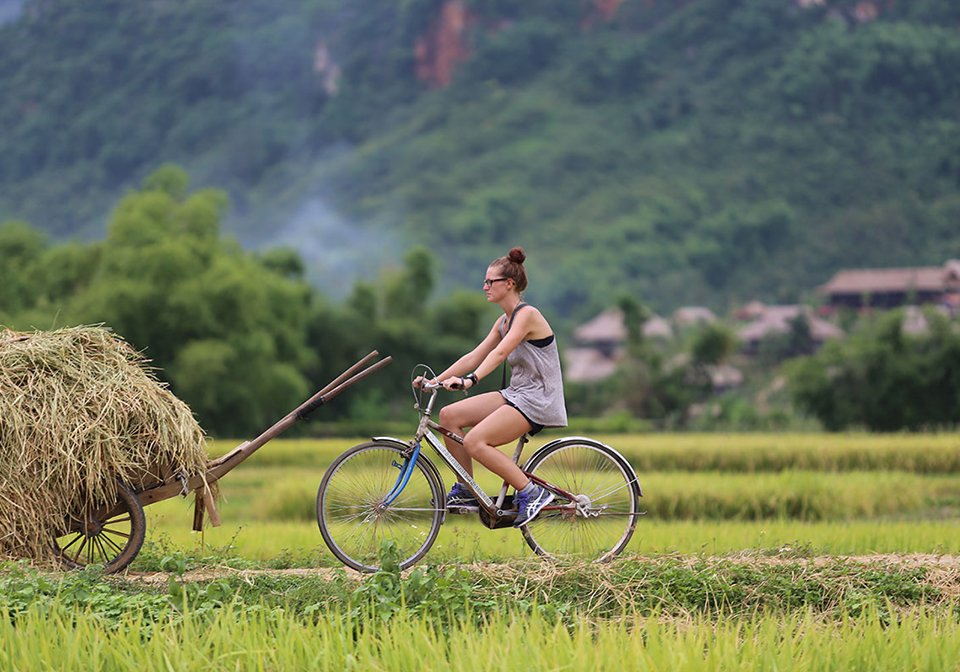
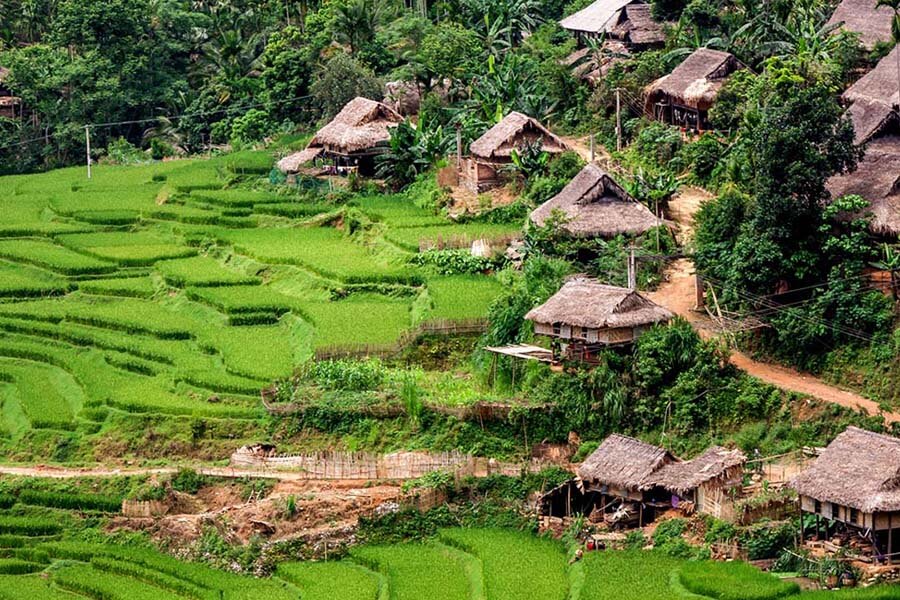
Far from the noise of busy cities, Pu Luong rewards travelers who prefer discovery over speed. One moment, you are climbing a shaded lane beneath towering trees; the next, you emerge into a sunlit valley where rice terraces follow the contours of the hills. Along the way, bamboo water wheels reveal the ingenuity of traditional irrigation, while stilt houses and village gardens offer glimpses into the everyday lives of local Thai and Muong communities.
For adventurous travelers, a Pu Luong Cycling Tour can combine the physical satisfaction of riding varied terrain with the sensory richness of rural Vietnam. It is an opportunity to feel the road beneath your tires, hear water flowing through irrigation channels, taste regional home cooking, and discover a landscape best explored at a slower pace.
With Golden Cycling Tours, you can explore cycling experiences in Pu Luong, Mai Chau, Ninh Binh, and other remarkable destinations across Northern Vietnam. Visit Golden Cycling Tours to begin planning a cycling holiday that matches your interests, fitness, and preferred travel style.
A cycling holiday in Pu Luong offers something different from a conventional sightseeing trip. Instead of watching the landscape pass from a vehicle window, you become part of it.
You feel each change in gradient, notice the temperature shift beneath the forest canopy, and hear the countryside gradually waking around you. A quiet lane may lead to a rice field, a wooden water wheel, or a small village where daily life continues much as it has for generations.
Pu Luong Nature Reserve, in Thanh Hoa Province, is known for its limestone mountains, forested slopes, rice terraces, streams, and rural settlements. Its varied landscapes create an appealing setting for travelers who enjoy combining outdoor activity with cultural discovery.
The terrain is particularly rewarding for cyclists who appreciate changing scenery. Valley roads can feel gentle and open, while higher routes may introduce steeper climbs, tighter bends, and rougher surfaces.
A typical day might begin beneath a pale veil of morning mist. As the sun rises, the clouds lift from the hills, revealing bright green terraces and clusters of houses scattered across the valley.
You stop to drink water. Somewhere nearby, a bird calls from the trees. The smell of damp earth rises from the roadside, and the soft clicking of your freewheel becomes audible as you coast toward the next village.
These are the details that transform a Pu Luong Cycling Tour into a memorable travel experience.
Not every rewarding cycling route needs to be a smooth mountain highway. Around Pu Luong, selected rural lanes and dirt paths can bring riders closer to agricultural landscapes and village life.
Depending on the route, you may encounter compacted earth, gravel, uneven sections, potholes, or paved roads connecting settlements. Surface conditions can change after rain, so the exact route should be checked before departure.
On a firm dirt path, the tires produce a satisfying, steady crunch. Loose gravel creates a sharper sound beneath the wheels, while damp earth feels darker and softer under the morning light.
You may need to ease off the pedals, shift into a lower gear, and choose your line carefully around stones or shallow ruts. Rather than chasing speed, the best approach is to ride with control and leave time to enjoy the surroundings.
For travelers seeking a combination of countryside riding and cultural encounters, these quieter roads are often among the most appealing parts of a Pu Luong Cycling Tour.
The bamboo water wheels associated with parts of the Pu Luong and Mai Chau region are among the most distinctive features of the local agricultural landscape.
Built beside streams, these traditional structures use flowing water to rotate their large wheels and lift water toward irrigation channels. Their design reflects practical knowledge developed to support farming in mountainous terrain.
As a wheel turns, bamboo components creak and water splashes back into the stream. The movement is gentle and repetitive, creating a striking contrast with the stillness of the surrounding hills.
For cyclists, a water wheel can be an excellent place to pause, take photographs, and learn about local irrigation practices from a knowledgeable guide or host.
Not every route passes directly beside a working water wheel, and their condition and accessibility can vary. Ask your tour operator to confirm which locations are included in your itinerary.
Please observe these structures from appropriate public access points, avoid climbing on them, and never interfere with irrigation equipment used by local farmers.
The combination of unpaved rural paths and traditional water wheels gives this cycling experience its distinctive character.
A road may lead away from a valley village and into a patchwork of cultivated fields. A stream appears beside the route, its surface reflecting the sky. Then, through the vegetation, you notice a large wooden-and-bamboo wheel turning at the water's edge.
Cycling allows you to hear details that might otherwise disappear beneath engine noise.
Listen to the tires rolling over dirt, the gentle rattle of the chain, the rush of a nearby stream, and the occasional creak of bamboo moving with the water.
In the early morning, village life may begin with roosters calling, dogs barking in the distance, and people preparing for a day of agricultural work.
The sounds are neither staged nor arranged for visitors. They are part of the living landscape, and experiencing them respectfully is one of the pleasures of traveling through Pu Luong.
After overnight rain, the paths around Pu Luong can carry the earthy fragrance of damp soil, fallen leaves, and fresh vegetation.
Near cultivated fields, you may notice the smell of grass and rice plants. Around village homes, the aroma of breakfast cooking can drift across the road, mixing with the scent of wood smoke.
These sensory details change with the weather and season. A dry afternoon may smell of warm earth, while a misty morning feels cooler and more intensely green.
Although some routes through Pu Luong follow relatively gentle valleys, other sections can involve demanding gradients.
As the road tilts upward, your breathing deepens. Your legs begin to work harder, and each pedal stroke requires a little more concentration. You shift to an easier gear, settle into a sustainable rhythm, and focus on the next safe section of road.
The bicycle moves steadily beneath you, its tires searching for grip on the surface. Sweat gathers along your forehead, while cool air brushes your face whenever the road opens between the trees.
At the top of a climb, the reward may be a broad view of terraced hillsides and limestone ridges.
The physical effort makes that moment feel earned. Yet a good Pu Luong Cycling Tour is not a race: the objective is to enjoy the journey while remaining comfortable and safe.
The right route depends on your fitness, available time, preferred bicycle, and interest in cultural stops. The suggestions below are route concepts rather than guaranteed itineraries; exact access, distances, elevation gain, and surfaces should be confirmed locally.
Ban Don is one of the best-known visitor areas in Pu Luong, with accommodation and access to scenic rural surroundings.
Cycling around the nearby valleys can reveal rice terraces, traditional houses, garden plots, and views across the surrounding mountains. Depending on the chosen route, the ride may include paved village roads, compacted dirt sections, and short climbs.
This area is particularly appealing for riders who want to combine moderate cycling with photography and time spent exploring local settlements.
Begin early if possible. Morning light can reveal the contours of the terraces before the midday heat arrives. Stop at safe locations to photograph the landscape rather than braking suddenly on narrow roads.
Best for: Leisure cyclists, couples, photographers, and travelers who want a relaxed introduction to rural cycling.
Ban Hieu is associated with the waterfall scenery and rural landscapes of Pu Luong.
Depending on your itinerary, you may ride along village roads and then continue on foot to reach the waterfall area. Access and walking conditions can vary, particularly after heavy rain.
The transition from cycling to walking gives you a different perspective on the landscape. You may hear the water before the waterfall comes into view, with its steady rush growing louder through the surrounding vegetation.
Wear shoes with good grip if your visit includes walking near water or on uneven paths. Avoid slippery rocks and follow local advice about safe access.
Best for: Travelers who want to combine cycling with nature walks and photography.
For travelers particularly interested in Pu Luong's bamboo water wheels, a village-focused route is worth discussing with the tour operator.
The ideal ride would link accessible rural roads with suitable stops near streams, irrigation channels, and traditional water-wheel structures. Because these features serve practical agricultural purposes, not every wheel will be publicly accessible or located beside a cycling route.
A local guide can help explain how the wheels operate and how they support farming communities.
Take time to observe the engineering: the wheel's movement, the position of its paddles, and the way water is directed into irrigation channels. The simplicity of the mechanism is part of its beauty.
Best for: Cultural travelers, photographers, and cyclists interested in traditional farming practices.
Riders seeking a greater physical challenge may prefer routes that climb away from the valley floor toward higher viewpoints.
The gradients can vary considerably, and some sections may be narrow or uneven. Ask for the expected elevation gain and the most demanding sections before selecting a route.
Climb steadily rather than accelerating early. On a steep section, a comfortable cadence is often more sustainable than forcing a large gear. On the descent, control your speed and anticipate bends before entering them.
The reward is a wider view of the region's landscape: forested ridges, cultivated slopes, and small settlements tucked between the hills.
Best for: Fit cyclists, experienced riders, and travelers who enjoy a more demanding day in the saddle.
Mai Chau and Pu Luong complement each other well on a multi-day cycling holiday.
Mai Chau Valley is known for its rice fields and Thai villages, while Pu Luong Nature Reserve offers forested slopes, mountain scenery, and opportunities to explore rural roads and traditional irrigation features.
A journey between the two areas can create a varied itinerary, although the exact road surface and difficulty depend on the route chosen.
Explore the 4-Day Northern Vietnam Cycling: Mai Chau to Pu Luong Cycling Adventure if you want to investigate a trip that connects these destinations.
Before booking, confirm whether the itinerary includes the specific dirt-path sections, bamboo water wheels, and village stops that interest you.
The weather influences road conditions, visibility, comfort, and the appearance of the rice terraces. The best month depends on whether you prefer green fields, golden harvest scenery, cooler temperatures, or a more flexible schedule.
Spring is often a pleasant period to consider for cycling in Pu Luong.
The countryside becomes increasingly green as agricultural activity progresses, and temperatures can be more comfortable than during the hottest part of summer. March and April may also bring misty mornings and occasional rain.
By May, conditions can become hotter and more humid. Begin early, carry sufficient water, and plan breaks around the most demanding climbs.
Why go: Fresh vegetation, rural scenery, and potentially comfortable morning riding.
Summer brings abundant greenery, and the mountains can appear especially vibrant after rainfall.
However, heavy showers, humidity, and slippery surfaces can make some dirt paths more difficult. Water levels may rise, and erosion or loose material can affect sections of rural roads.
Check the forecast before departure and keep your itinerary flexible. If a route becomes unsafe, choose an alternative rather than attempting a difficult descent in poor conditions.
Why go: Rich green scenery and a landscape that feels alive with water and vegetation, provided conditions allow safe riding.
September and October are often attractive months for travelers who want to see the rice terraces around Pu Luong.
Depending on the local planting schedule and weather, the fields may turn golden as harvest approaches. The contrast between yellow rice, green forest, and grey limestone creates memorable photographic opportunities.
The harvest calendar varies between locations and years, so golden fields cannot be guaranteed on a particular date.
Rain can also occur during this period. Check the forecast and ask local hosts about current road conditions.
Why go: Potential golden rice terraces, dramatic mountain scenery, and excellent opportunities for landscape photography.
Winter can bring cooler mornings, cloud, mist, and damp conditions to Pu Luong.
Some days reveal clear mountain views, while others remain grey and misty. Dirt paths can become slippery when wet, and shaded sections may stay damp for longer than expected.
Bring a warm layer for early starts and descents, and allow time for the weather to change.
Why go: Quiet rural scenery, cooler riding conditions, and an atmospheric mountain landscape when the weather cooperates.
For a balance of cycling comfort and scenic variety, consider March to May or September to October.
If bamboo water wheels and rural farming landscapes are your main interest, the experience can be rewarding across different seasons. The appearance of the rice terraces and the flow of streams will vary with rainfall and the agricultural calendar.
Regardless of the month, confirm the planned route and weather conditions shortly before your ride.
Food is an important part of experiencing rural Northern Vietnam. After several hours of pedaling, a warm meal made with fresh ingredients can be one of the day's most satisfying rewards.
The communities around Pu Luong include Thai and Muong residents whose food traditions reflect local ingredients, farming, and family cooking.
Depending on the household or restaurant, you may find:
Com lam: Rice cooked inside bamboo tubes, often served with grilled dishes.
Grilled chicken: Chicken seasoned with herbs and spices and cooked over charcoal.
Sticky rice: A familiar staple that pairs well with meat and vegetables.
Fresh seasonal vegetables: Prepared simply or cooked with local seasonings.
Grilled fish: Available at some establishments, depending on supply.
Local herbs and dipping sauces: Ingredients that add fragrance, freshness, and regional character to a meal.
Availability varies by location and season. Ask about ingredients if you have allergies, dietary restrictions, or food preferences.
Homestays around Ban Don and nearby villages can be a good starting point for regional home cooking. Many properties can arrange meals for overnight guests, particularly when you request dinner in advance.
Some lodges and restaurants in the visitor areas also serve Vietnamese dishes and local specialties. Ask your accommodation host or tour operator for current recommendations along your cycling route.
For a cycling day, aim for a substantial breakfast and a balanced lunch. If your itinerary passes through remote areas, carry snacks because shops may be limited or closed when you arrive.
Vietnamese coffee offers a rich roasted aroma and a distinctive flavor that many travelers enjoy during a morning stop.
Fresh fruit, tea, and water are also useful options. During hot or humid weather, prioritize hydration and consider suitable electrolyte replacement on longer rides.
Carry enough drinking water for the distance between reliable refill points. Do not assume that every village will have bottled water available at convenient times.
A good place to stay can make a cycling holiday more comfortable, especially when your route includes climbing, uneven surfaces, or several consecutive days in the saddle.
Staying in a homestay offers an opportunity to experience local hospitality and remain close to village life.
Depending on the property, you may sleep in a traditional-style stilt house, a shared room, or a private room with modern facilities. You may hear insects at night, wake to birdsong, and smell breakfast cooking as the valley begins to brighten.
Facilities vary, so ask about bathrooms, hot water, bedding, meals, privacy, and secure bicycle storage before confirming your stay.
A homestay can be particularly rewarding for travelers interested in cultural exchange, but respect the household's routines and privacy.
Pu Luong also has nature-oriented lodges and retreats, some with views over rice terraces or mountain valleys.
Depending on the property, you may find private rooms, balconies, gardens, swimming pools, or on-site dining. These facilities can be appealing after a physically demanding ride.
Check the property's precise location and room type if scenery is important to you. A photograph of the general landscape does not necessarily guarantee a terrace or a direct mountain view from your room.
Before choosing accommodation, confirm:
Whether bicycles can be stored securely overnight.
Whether breakfast can be served early enough for your planned departure.
Whether dinner and drinking water are available.
Whether laundry services are offered.
Whether the property is close to your route.
Whether staff can help arrange transport if the weather changes or a rider cannot continue.
During popular travel periods, reserve accommodation in advance, especially if you want a specific room type or a small village property.
Most international travelers begin in Hanoi, which offers extensive domestic and international transport connections.
A private vehicle is a convenient choice for reaching Pu Luong, especially when carrying bicycles, luggage, and cycling equipment.
The journey usually takes several hours, depending on traffic, road conditions, and the final destination within the region. Confirm the estimated travel time and pickup point with your driver or tour operator.
Private transfers also allow more flexibility for rest stops and make it easier to coordinate a multi-day cycling itinerary.
Bus and shared-vehicle services may be available between Hanoi and parts of the wider Thanh Hoa or Mai Chau region. Routes, schedules, departure points, and onward connections vary.
Before choosing public transport, confirm how you will reach your accommodation from the final stop. Rural properties may be some distance from a major bus station.
Ask in advance whether bicycles are accepted and whether additional arrangements or fees apply.
When considering a Pu Luong Cycling Tour, ask whether your selected package includes transfers, bicycle rental, luggage transport, meals, accommodation, a guide, or a support vehicle.
Do not assume that every tour includes the same services. Request a written itinerary that specifies the meeting point, route distances, elevation gain, and arrangements for luggage and mechanical problems.
Browse the Golden Cycling Tours collection to compare available itineraries and discuss your requirements with the operator.
The cultural identity of Pu Luong is closely connected to farming, family life, traditional architecture, and the surrounding landscape.
Thai and Muong communities have distinctive traditions, and local experiences can differ between villages and households. Travelers may encounter stilt houses, gardens, rice fields, weaving traditions, and home-cooked meals.
When visiting a village, greet people politely and follow your host's guidance. Ask permission before photographing individuals, children, or private homes.
A guide who understands the local language and customs can help explain traditions and make interactions more meaningful.
Traditional bamboo water wheels are more than picturesque features beside a stream. They demonstrate practical knowledge of local water management.
Their rotating structures harness the movement of flowing water to lift it toward irrigation channels. This can help deliver water to cultivated land in areas where terrain makes irrigation challenging.
Observe how the wheel is positioned in relation to the stream and how the lifted water enters its channel. If a local guide explains the mechanism, take the opportunity to learn about its role in agricultural life.
Because these structures may still serve local needs, do not climb on them, alter their components, or obstruct access to irrigation channels.
Rural roads are shared spaces, not dedicated cycling tracks.
Slow down when passing houses, pedestrians, children, livestock, and agricultural work. Avoid loud music, unnecessary horn use, and sudden movements.
Do not enter private property or cultivated fields without permission. If you stop for photographs, choose a safe place that does not block traffic or disrupt farm work.
Small acts of consideration help ensure that tourism remains welcome in the communities you visit.
Responsible travel is particularly important around Pu Luong Nature Reserve.
Carry your rubbish out, use reusable bottles where practical, remain on permitted routes, and avoid disturbing wildlife. Follow local guidance on trails, streams, and protected areas.
Support local accommodation providers, restaurants, and guides where possible. Spending money locally can help make tourism more beneficial to the communities whose landscapes and traditions attract visitors.
A cycling holiday can be combined with short walks, village visits, and other regional attractions.
The reserve is the central attraction for nature lovers, with forested slopes, limestone mountains, agricultural valleys, and rural settlements.
Depending on access and your schedule, you can combine cycling with walking, photography, or time spent relaxing at your accommodation.
Follow local advice about route access, particularly after heavy rainfall.
Ban Hieu Waterfall is a well-known natural attraction associated with Pu Luong.
The surrounding landscape offers flowing water, shaded vegetation, and opportunities for short walks. Depending on your route, you may need to leave the bicycle at an appropriate location and continue on foot.
Wear suitable footwear and avoid slippery rocks, especially when water levels are high.
Ban Don is a useful base for exploring rice terraces and nearby rural roads.
The area offers opportunities to enjoy mountain views, visit traditional-style accommodation, and experience local meals. Early morning and late afternoon can be especially atmospheric as the light changes across the valley.
Kho Muong Village is known for its mountain setting and access to Kho Muong Cave, also called Bat Cave.
Access routes and walking conditions can vary, so ask locally about current conditions before visiting. Wear suitable footwear and follow any restrictions or safety guidance.
Mai Chau Valley is an excellent companion destination for travelers who want to combine rural cycling with cultural exploration.
Its rice fields and Thai villages provide a different landscape from the more mountainous terrain around Pu Luong Nature Reserve.
Explore Mai Chau Bike Tours or consider the 4-Day Mai Chau to Pu Luong Cycling Adventure.
If you have extra time, Ninh Binh offers limestone karsts, rivers, rice fields, and historical attractions.
Highlights include Trang An Scenic Landscape Complex, Tam Coc, Hoa Lu Ancient Capital, and Mua Cave viewpoint.
Explore Ninh Binh Bike Tours for ideas on combining countryside cycling with sightseeing.
Travelers planning a longer adventure can compare Ha Giang and Cao Bang, two destinations known for dramatic mountain landscapes.
In Ha Giang, attractions include Ma Pi Leng Pass and the Dong Van Karst Plateau. In Cao Bang, Ban Gioc Waterfall and Nguom Ngao Cave are major highlights.
Explore Ha Giang Bike Tours and Cao Bang Bike Tours to discover other cycling possibilities in Northern Vietnam.
The bicycle you choose should match the route's surface, gradients, and your own experience.
A mountain bike can be a sensible option for routes with rougher dirt paths, loose gravel, uneven surfaces, and steep sections.
Wider tires and appropriate gearing can improve control and comfort. Front suspension may help on rough terrain, although the ideal setup depends on the actual route.
Check the brakes, tires, drivetrain, and saddle before starting your ride.
A gravel bike can work well on routes that combine paved roads with firm dirt and manageable gravel sections.
Tire width, tread, gearing, and rider experience matter. A route with deep ruts, loose stones, or very rough surfaces may be less comfortable or suitable on a gravel bike than on a mountain bike.
Ask the operator for a realistic description of the terrain before deciding.
An electric-assist bicycle can help riders manage climbs and maintain a comfortable effort over longer days.
However, an e-bike still requires balance, braking skills, and attention to road conditions. Battery range depends on terrain, rider weight, assistance level, and battery condition.
Confirm charging opportunities and backup arrangements before departure. Explore Vietnam E-Bike Tours if electric-assist cycling appeals to you.
This illustrative itinerary shows how cycling, village visits, and regional scenery could fit together. It is not a guarantee of a published tour schedule. Actual routes, distances, accommodation, and inclusions must be confirmed with the operator.
Leave Hanoi and travel toward Mai Chau, watching the landscape change from urban streets to rural valleys and mountain scenery.
After checking in, take a short introductory ride if time and conditions allow. Test your bicycle, adjust your saddle, check the brakes, and make sure your equipment is ready for the following days.
Enjoy a relaxed dinner and rest before the main ride.
Begin early, when the air is cool and the countryside is quiet.
Ride through the landscapes around Mai Chau before continuing toward Pu Luong, following the route arranged for your trip. Expect the terrain and road surface to vary according to the selected itinerary.
Pause for photographs, drink water regularly, and maintain a steady pace on climbs.
Arrive at your accommodation with enough time to enjoy dinner and the evening mountain atmosphere.
Spend the day exploring selected rural roads and village areas around Pu Luong Nature Reserve.
Where access allows, include stops near traditional bamboo water wheels, streams, rice terraces, and local settlements. A guide can help explain the irrigation system and the relationship between farming and the landscape.
Depending on your interests and the weather, you may also visit Ban Don or arrange a walk near Ban Hieu Waterfall.
Keep the schedule flexible so you can enjoy the countryside rather than rushing between stops.
Start with a short morning ride or walk, depending on the itinerary and weather.
After breakfast, prepare for the return transfer or continue to another destination such as Ninh Binh.
If you want to extend your trip, browse Golden Cycling Tours and compare available itineraries across Northern Vietnam.
A route that feels comfortable in dry weather may become slippery after rain.
Ask about recent rainfall, road closures, erosion, and the condition of stream crossings. If a section appears unsafe, stop and seek advice rather than attempting it simply to stay on schedule.
Steep slopes, loose gravel, blind corners, pedestrians, and livestock can create hazards.
Reduce speed before entering a bend, maintain a safe distance from other riders, and avoid sudden braking on loose surfaces. Do not overtake where visibility is limited.
Heat and humidity can increase fatigue, especially on climbs.
Bring enough drinking water, suitable snacks, sun protection, and a lightweight waterproof layer. A warm layer can also be useful during cool morning starts.
Before departure, test the brakes, tires, gears, and wheel security.
If you are renting a bicycle, report any problems before leaving. Ask whether repair equipment, spare parts, or mechanical assistance will be available along the route.
Ask whether the tour includes a guide, luggage transfer, a support vehicle, or assistance in case of injury or mechanical failure.
These services vary by itinerary. Make sure the arrangements are stated clearly in your booking confirmation, especially if you will ride through remote areas.
Planning a cycling trip involves more than choosing a beautiful destination. You also need to understand the route, transport arrangements, bicycle options, accommodation, meals, and support services.
Golden Cycling Tours is a useful starting point for exploring cycling itineraries in Pu Luong and other Northern Vietnam destinations.
Use these destination pages to compare possibilities:
Pu Luong Bike Tours — Explore cycling options associated with Pu Luong Nature Reserve.
Mai Chau Bike Tours — Discover rural cycling routes around Mai Chau Valley.
Ninh Binh Bike Tours — Explore limestone landscapes and countryside routes.
Cycling Northern Vietnam — Compare destinations across Northern Vietnam.
Vietnam Northeast Bike Tours — Explore mountain-focused itineraries farther north.
Ba Be Lake Bike Tours — Discover cycling options around Ba Be Lake.
Vietnam Luxury Bike Tours — Investigate comfort-focused cycling experiences.
Vietnam E-Bike Tours — Compare electric-assist cycling options.
Depending on your available time and interests, you may also want to explore:
4-Day Northern Vietnam Cycling: Mai Chau to Pu Luong Cycling Adventure — A relevant option for investigating a combined Mai Chau and Pu Luong journey.
6-Day Mai Chau–Pu Luong–Ninh Binh E-Bike Tour — An option to consider if you want to combine several destinations with electric-assist cycling.
15-Day Best Vietnam Cycling Northeast Tour — For travelers considering a longer journey.
10-Day Ha Giang Loop and Hoang Su Phi Cycling Adventure — An alternative focused on the northern highlands.
8-Day Northern Vietnam Cycling Tour: Epic Ha Giang Loop Adventure — A mountain-focused itinerary to compare.
12-Day North Vietnam Cycling Adventure: Hanoi to Ninh Binh — Another option for a broader cycling journey.
These itineraries cover different destinations and riding experiences. Do not assume that each includes dirt paths or bamboo water wheels around Pu Luong. Ask Golden Cycling Tours to confirm the exact route, current availability, accommodation, bicycle options, and support services before booking.
To compare options or make an inquiry, visit Golden Cycling Tours or browse all available tours.
Yes, if you select a route that matches your fitness and experience. Some valley roads are relatively gentle, while other routes involve steep climbs, loose surfaces, or narrow dirt paths.
Beginners should prioritize manageable distances, moderate elevation gain, and time for breaks. Ask the operator for details of the actual route before booking.
Some routes may include dirt or gravel sections, but the surface varies by itinerary and weather.
Confirm whether your planned route includes unpaved paths and ask about recent conditions. Do not assume that every cycling tour in Pu Luong follows dirt roads.
Traditional water wheels can be found in parts of the Pu Luong and nearby Mai Chau region. Their locations, condition, and accessibility vary.
If visiting water wheels is a priority, ask your tour operator to identify suitable stops on the proposed route. Observe the structures respectfully because they may support local irrigation.
March to May and September to October are often good periods to consider.
Spring can offer fresh green scenery, while September and October may bring golden rice terraces depending on the local harvest calendar. Weather and road conditions vary, so check the forecast before traveling.
A mountain bike is often a sensible choice for rougher surfaces and steep sections, but the best option depends on the actual route.
A suitable gravel bike may work well on firm dirt and paved roads. Ask about tire width, surface conditions, and elevation gain before choosing.
Yes. Mai Chau and Pu Luong make a natural pairing for travelers who want to explore rice fields, traditional villages, and mountain scenery.
Explore the 4-Day Mai Chau to Pu Luong Cycling Adventure and confirm its current itinerary and inclusions.
An electric-assist bicycle can help riders manage climbs and maintain a comfortable effort.
However, an e-bike still requires good balance, braking control, and attention to uneven surfaces. Confirm battery range, charging arrangements, and bicycle availability before booking.
Homestays and local restaurants around Ban Don and nearby villages are good places to investigate for regional home cooking.
Ask your accommodation host or tour operator for current recommendations. If you have food allergies or dietary restrictions, communicate them before meals are prepared.
Options include traditional-style homestays, guesthouses, and nature-oriented lodges.
Choose according to your preferred comfort level, location, meal arrangements, and bicycle storage needs. Confirm facilities directly with the property before booking.
Many travelers use a private transfer from Hanoi because it offers flexibility and can accommodate cycling equipment.
Bus or shared transport may also be possible, depending on the route and schedule. Confirm the onward connection to your accommodation and check whether bicycles are accepted.
Support arrangements depend on the selected itinerary. Some tours may include vehicle assistance or luggage transfer, while others may have different arrangements.
Ask for written confirmation of what is included, when the vehicle is available, and what assistance is provided for mechanical problems or unexpected changes.
Visit Golden Cycling Tours or browse the tour collection.
Share your preferred dates, group size, cycling experience, bicycle preference, and comfort requirements. Request the full itinerary, route difficulty, accommodation details, and included services before confirming your booking.
Authentic customer reviews help future travelers understand the quality of a cycling experience. They should reflect real journeys and should only be published with appropriate permission.
The following is an illustrative review template, not a genuine customer testimonial. Replace it with verified feedback before publication.
Title: Discovering the Rural Beauty of Pu Luong by Bicycle
“We enjoyed exploring the countryside around Pu Luong Nature Reserve at a relaxed pace. The rice terraces, quiet village roads, and traditional bamboo water wheels made the journey feel distinctive and memorable. We especially appreciated having time to stop for photographs and learn about local farming practices.
The climbs required effort, but the changing scenery and peaceful atmosphere made the experience rewarding.”
Editorial note: This text is fictional and must not be presented as a real customer review. Replace it with an approved quotation from an actual guest. Include a verified tour name or travel date only when that information is available.
When comparing operators, look for specific feedback about:
Whether the route matched the advertised difficulty.
The condition and suitability of the bicycles.
The guide's communication and local knowledge.
The quality of accommodation and meals.
How mechanical issues and weather changes were handled.
Whether the delivered services matched the booking confirmation.
Specific, verifiable experiences provide more value to future customers than exaggerated or unverifiable claims.
There is something deeply satisfying about discovering Pu Luong Nature Reserve from the saddle of a bicycle.
The day begins with cool air and the soft glow of morning light. Your tires roll along a narrow rural path, the chain clicks as the road rises, and the green mountains slowly emerge from the mist. Near a stream, a bamboo water wheel turns steadily, lifting water toward the fields as it has done for generations.
You pause, catch your breath, and listen. Water moves over stones, birds call from the trees, and the countryside carries on around you. Later, a home-cooked meal brings the aroma of grilled food, fresh herbs, and warm rice to the table.
These are the moments that make a Pu Luong Cycling Tour more than a journey between destinations. It is a chance to connect with the landscapes, agricultural traditions, and everyday life of Northern Vietnam.
Whether you prefer relaxed village rides, adventurous dirt paths, or a multi-day journey connecting Mai Chau, Pu Luong, and Ninh Binh, the right itinerary can turn a cycling holiday into a meaningful travel experience.
Explore Pu Luong Bike Tours, compare the Mai Chau to Pu Luong Cycling Adventure, and visit Golden Cycling Tours to discuss your plans.
The road may be dusty, the climbs may test your legs, and the weather may change without warning. But with thoughtful planning, the journey can reward you with mountain views, traditional water wheels, quiet village encounters, and memories that stay with you long after the wheels stop turning.

.jpg "Pu Luong Cycling Tours")
Leave a Reply
Your email address will not be published. Required fields are marked *