- Call us Via Whatsapp: +84 (0) 832 126 699
4.9 stars on our site
(15,000 reviews)
- Monday - Sunday : 08:00 - 17:00
(15,000 reviews)

Discover Vietnam from the saddle of a mountain bike, where dramatic limestone mountains rise above emerald valleys, narrow trails wind through ancient forests, and quiet villages reveal a way of life shaped by the rhythm of the seasons. With Golden Cycling Tours, every ride becomes an opportunity to explore beyond the ordinary, combining challenging cycling routes, authentic cultural encounters, expert local guidance, and dependable support throughout your journey.
Our Guided Vietnam MTB Tours with Full Support Van & Spare Bikes are designed for riders who want the freedom and excitement of mountain biking without the stress of managing every logistical detail themselves. Whether you dream of conquering the legendary mountain passes of Ha Giang, discovering remote trails in Cao Bang, riding through the rice terraces of Hoang Su Phi, or exploring the peaceful countryside of Mai Chau and Pu Luong Nature Reserve, a professionally supported cycling adventure allows you to experience more of Vietnam with confidence.
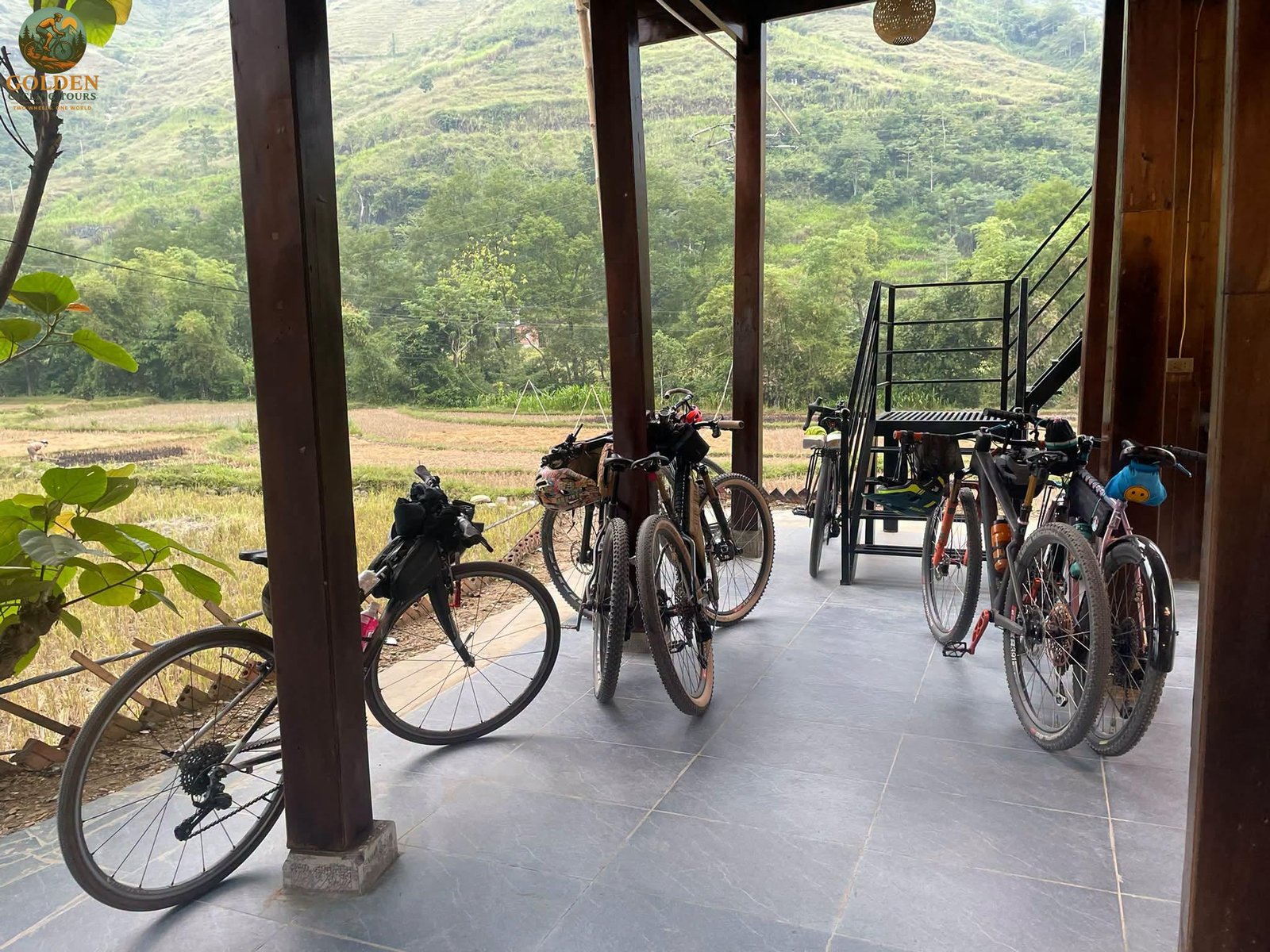
A dedicated support vehicle, carefully maintained bicycles, and spare-bike arrangements can make a significant difference on multi-day cycling expeditions. When the road climbs relentlessly toward a mountain summit, the weather changes unexpectedly, or a mechanical problem interrupts the ride, a well-organized support team helps keep the journey moving.
This is mountain biking in Vietnam at its most rewarding: wild landscapes, powerful physical challenges, unforgettable local encounters, and the reassurance of knowing that experienced people are working behind the scenes to support your adventure.
Ready to discover Vietnam on two wheels? Explore the cycling adventures available through Golden Cycling Tours and find the route that matches your riding experience, fitness, and travel ambitions.
Mountain biking in Vietnam is about much more than riding from one destination to another. It is about experiencing the changing character of the landscape, from mist-covered mountain ridges to sunlit rice terraces, from remote ethnic minority villages to bustling local markets.
However, the country's mountainous terrain can present real challenges. Long climbs, steep descents, changing road surfaces, humid weather, and considerable distances between towns require careful planning.
Our approach to Guided Vietnam MTB Tours with Full Support Van & Spare Bikes combines adventure with practical support, helping riders concentrate on the experience rather than worrying about every detail of the journey.
Imagine leaving the busy streets of Hanoi behind and entering the mountainous world of northern Vietnam.
The road gradually narrows as the city disappears into the distance. Fields of rice spread across the valleys, limestone peaks emerge through the morning mist, and small villages appear along the roadside. The air becomes cooler as the road climbs higher.
Soon, the sounds of traffic give way to the quiet rhythm of the countryside: birds calling from the trees, water flowing through irrigation channels, and the gentle clicking of your bicycle drivetrain as you settle into a steady climbing pace.
Guided MTB tours provide opportunities to explore areas that many conventional travelers never experience.
Depending on the itinerary, your journey may include:
Remote mountain roads and selected off-road sections.
Quiet countryside lanes passing through rice-growing communities.
Challenging mountain climbs and flowing descents.
Traditional villages inhabited by Hmong, Tay, Dao, Thai, and other ethnic communities.
Scenic viewpoints overlooking valleys, forests, and limestone formations.
Local markets, family-run restaurants, and traditional homestays.
The exact terrain varies by route. Some itineraries focus on paved mountain roads, while others incorporate gravel tracks, dirt roads, and more technical off-road sections. Before booking, discuss your preferred riding style with your tour operator to ensure that the route suits your expectations.
A dedicated support van is one of the most valuable features of a multi-day mountain biking holiday.
Instead of carrying all your luggage, spare clothing, tools, snacks, and overnight essentials on your bicycle, you can enjoy the ride with a lighter setup.
Depending on the tour arrangements, the support vehicle may carry:
Main luggage and additional clothing.
Drinking water, fruit, and refreshments.
First-aid supplies and essential repair equipment.
Spare components and selected replacement equipment.
Spare bicycles, where arranged and compatible with the tour.
Tired riders who need to stop cycling temporarily.
On a long mountain climb, knowing that refreshments and assistance are available can provide genuine peace of mind.
Picture yourself approaching a demanding pass in the northern highlands. Your breathing becomes deeper, your legs begin to burn, and the road curves toward a ridge that seems impossibly high. After another switchback, you reach a viewpoint where the mountains stretch into the distance.
The support vehicle allows the team to coordinate refreshments and assistance at appropriate points along the route, subject to road access and the itinerary.
It is important to understand that a support van cannot always follow riders directly onto narrow singletrack trails or inaccessible mountain paths. Your guide will explain how vehicle access and meeting points work on each riding day.
Mechanical reliability matters when cycling far from major towns.
A minor problem near a city may be easy to solve. The same problem on a remote mountain road can become much more complicated if replacement parts or suitable repair facilities are hours away.
For this reason, spare-bike arrangements and mechanical support are important considerations when selecting a guided MTB expedition.
Depending on the tour, available support may include:
A replacement bicycle if the original bike develops a serious mechanical problem.
Basic trailside repairs for punctures and common mechanical issues.
Assistance with brake adjustments, gear shifting, and other routine problems.
Essential tools and selected spare components.
Help arranging further repairs when specialist workshop services are needed.
A spare bicycle is not necessarily available at every point on every tour. Availability depends on the number of riders, bicycle sizes, frame compatibility, route accessibility, and the support arrangements confirmed before departure.
When booking, ask whether a spare bike is included, whether it is carried in the support vehicle, and what happens if your particular frame size is unavailable.
For technical MTB trips, these details are worth confirming in advance.
A great mountain biking guide does much more than lead the group along a road.
Local knowledge helps the group understand which climbs require a steady pace, where loose gravel may affect traction, which descents demand extra caution, and where a short stop offers the most rewarding view.
Guides can also introduce travelers to the stories behind the landscapes, explain local customs, and help arrange respectful visits to villages and markets.
With Golden Cycling Tours, the aim is to combine the excitement of riding with a deeper understanding of the places through which you travel.
Vietnam offers an extraordinary range of cycling environments within one country.
The north is famous for its towering mountains, dramatic passes, and terraced rice fields. Central Vietnam combines forested hills, agricultural landscapes, and historic towns. Further south, riders can explore highland plateaus, plantations, and varied rural landscapes.
For mountain bikers, the greatest attraction is the contrast between these environments and the opportunity to encounter them at bicycle speed.
Northern Vietnam is an outstanding choice for riders who enjoy long climbs, winding roads, dramatic viewpoints, and remote communities.
The region's most memorable cycling destinations include Ha Giang, Cao Bang, Hoang Su Phi, Dong Van Karst Plateau Geopark, Ba Be Lake, Sapa, and Bac Ha.
Each destination has a distinctive character.
Ha Giang offers spectacular limestone scenery and challenging mountain roads. Cao Bang is known for waterfalls, forested hills, and quiet borderland landscapes. Hoang Su Phi is famous for sweeping terraced rice fields carved into steep mountain slopes.
In the northwest, Sapa and Bac Ha combine mountainous riding with colorful local markets and opportunities to learn about ethnic minority cultures.
Explore more destinations through these pages:
Few cycling destinations create such a powerful sense of adventure as Ha Giang.
The landscape is dominated by rugged limestone formations, steep valleys, twisting mountain roads, and villages perched above terraced fields. The further you travel from the main towns, the more the scenery begins to feel like a world apart.
One of the region's defining experiences is riding the legendary Ma Pi Leng Pass.
The road clings to the mountainside, revealing dramatic views across the deep gorge of the Nho Que River. Limestone walls rise above the water, while the river winds through the valley in striking shades of green and turquoise.
On a clear day, the panorama is extraordinary. On misty mornings, the mountains appear and disappear through drifting clouds, creating an atmosphere that feels almost otherworldly.
Other highlights include Quan Ba Heaven's Gate, the famous Twin Mountains, Dong Van Old Quarter, and the historic Happiness Road.
For riders seeking a demanding, immersive northern Vietnam experience, explore:
These trips offer different ways to experience the northern highlands. Review each itinerary for the actual riding distances, elevation gain, terrain, and support arrangements before choosing your adventure.
Further east, Cao Bang offers a different kind of mountain biking experience.
The landscape alternates between limestone mountains, agricultural valleys, small villages, and quiet rural roads. It is a destination for travelers who want to discover the quieter side of northern Vietnam.
One of the region's most celebrated natural attractions is Ban Gioc Waterfall, where water cascades over a broad limestone formation near the Chinese border.
The surrounding area offers beautiful scenery, traditional villages, and opportunities to experience rural life away from Vietnam's busiest tourist centers.
Other attractions include Nguom Ngao Cave, the scenic landscapes around Trung Khanh, and Ba Be Lake, a freshwater lake surrounded by forested limestone mountains.
Depending on your itinerary, cycling in this region may involve sustained climbs, rolling roads, and varied surfaces. Ask your guide which sections are suitable for your preferred bicycle and technical ability.
Explore Vietnam Northeast Bike Tours to discover more regional possibilities.
Few landscapes are as visually striking as the rice terraces of Hoang Su Phi.
Here, entire mountainsides have been shaped into curved agricultural steps. During the growing season, the terraces glow in shades of green. At harvest time, the hills turn gold, while the early morning mist softens the outlines of the ridges.
The riding can be physically demanding. Roads climb between villages, bend around steep slopes, and descend into valleys where streams pass through cultivated land.
At times, the only sounds are your tires rolling over the road, the soft click of the gears, and the wind moving through the vegetation.
This is a particularly rewarding destination for photographers, experienced cyclists, and travelers who appreciate remote landscapes.
Explore the 10-Day Ha Giang Loop & Hoang Su Phi Cycling Adventure for an itinerary combining mountain scenery, challenging riding, and cultural discovery.
A well-organized support system can transform a challenging cycling holiday into a more manageable and enjoyable experience.
However, the precise services included vary between tours. The following sections explain the main arrangements travelers should discuss before booking.
On a supported cycling tour, your main luggage can generally travel separately from your bicycle, allowing you to carry only the essentials needed during the day.
A typical morning may begin with breakfast at a local hotel or homestay. While riders prepare their bicycles, the support team organizes luggage and checks the day's logistics.
After a briefing, the group sets off along the planned route.
During the ride, the support vehicle travels along accessible roads and meets the group at suitable locations. At the end of the day, luggage is transferred to the overnight accommodation according to the itinerary.
This arrangement allows you to concentrate on riding without carrying unnecessary weight over long mountain climbs.
Long days in the saddle require thoughtful pacing and regular hydration.
The support team may organize water, fruit, snacks, and rest stops, depending on the tour's inclusions. Your guide can also help adjust the pace when conditions change or when a rider needs additional recovery time.
For example, a group approaching a long climb in Ha Giang might take a short break at a village or viewpoint before continuing toward the summit.
If someone becomes exhausted, the support vehicle may be able to transport them and their bicycle to a suitable meeting point or the next destination.
The exact arrangements depend on road access, vehicle capacity, safety considerations, and the needs of the group.
A suitable bicycle is essential for a comfortable and safe riding experience.
Before departure, provide your height, approximate inseam, riding experience, and preferred bicycle type. This information helps the operator select an appropriate frame and prepare the bicycle.
Depending on the tour, available bicycles may include mountain bikes with front suspension, gravel bikes, or electric mountain bikes.
Mountain bikes are generally preferable for rougher tracks, loose surfaces, and technical terrain. Gravel bikes may be suitable for routes dominated by paved mountain roads and smoother gravel sections, but they are not ideal for every technical singletrack trail.
Electric mountain bikes can provide additional assistance on long climbs, although battery capacity and charging opportunities must be considered when planning each day.
Before the first ride, check:
Brake operation and pad condition.
Tire condition and appropriate pressure.
Gear shifting and drivetrain performance.
Wheel security and suspension function.
Saddle height, handlebar position, and overall fit.
Helmet fit and essential repair equipment.
If you have specific requirements for a replacement bicycle, such as an XL frame, particular suspension setup, or preferred pedal system, confirm these details with the tour operator before booking.
Not every cycling expedition uses the same type of support vehicle.
A passenger van is useful for transporting people and selected equipment, but it may not have enough space for several bicycles and all group luggage.
Larger groups may require separate luggage and bicycle transport. A dedicated bike truck can help carry bicycles securely while a passenger vehicle transports riders and staff.
For this reason, ask whether your chosen tour uses a passenger van, a dedicated bicycle truck, or a combination of vehicles.
The best setup depends on group size, luggage volume, road access, bicycle dimensions, and the itinerary.
Choosing the right region is one of the most important decisions when planning a mountain biking holiday in Vietnam.
Some riders want demanding mountain passes and long climbing days. Others prefer a combination of countryside cycling, cultural activities, and comfortable accommodation.
Mai Chau is an excellent starting point for riders who want to experience northern Vietnam's countryside without committing immediately to the most demanding mountain routes.
The valley is surrounded by green hills and agricultural land. Traditional Thai stilt houses stand beside rice fields, and narrow lanes connect small communities.
Cycling through the valley allows you to appreciate everyday rural life at close range. You may pass farmers working in the fields, children walking home from school, or families preparing meals in open kitchens.
The aroma of freshly cooked rice drifts through villages, while the sound of bicycles rolling over quiet roads creates a gentle rhythm.
Nearby, the surrounding hills provide opportunities for more challenging rides, depending on the chosen route.
Explore Mai Chau Bike Tours or consider the 4-Day Northern Vietnam Cycling: Mai Chau to Pu Luong Cycling Adventure.
Pu Luong Nature Reserve is one of northern Vietnam's most appealing destinations for travelers seeking a combination of nature, cycling, and rural culture.
The landscape includes forested limestone hills, terraced fields, small streams, and villages connected by winding rural roads.
Riding here is as much about the atmosphere as the physical challenge.
The morning air can be cool and damp. Mist hangs above the valleys, and sunlight gradually illuminates the rice terraces. Water wheels turn beside streams, while traditional houses sit among trees and cultivated land.
The terrain varies considerably. Some routes are relatively gentle, while others involve substantial climbs or rougher surfaces.
Cyclists should confirm whether their selected itinerary follows paved roads, gravel tracks, or technical trails.
Discover Pu Luong Bike Tours and explore the 4-Day Mai Chau to Pu Luong Cycling Adventure.
Ba Be Lake offers a different atmosphere from the exposed limestone passes of Ha Giang.
The lake lies within Ba Be National Park, an area of forests, limestone mountains, waterways, and traditional villages.
Cycling in the surrounding region can combine quiet rural roads with visits to viewpoints and lakeside communities.
A boat excursion on the lake may be a welcome change after several hours of riding. From the water, forested slopes rise above the shoreline, and small settlements appear along the banks.
Explore Ba Be Lake Bike Tours for inspiration when planning a northern Vietnam cycling itinerary.
The northwestern highlands offer a distinctive combination of mountain scenery and cultural diversity.
Sapa is famous for terraced rice fields, steep valleys, and views toward the Hoang Lien Son mountain range. Nearby villages provide opportunities to learn about the daily lives and traditions of local communities.
Bac Ha is known for its colorful markets and highland villages, where ethnic minority communities gather to trade agricultural products, clothing, and everyday goods.
Cycling in these areas can involve sustained climbing, cool mornings, and rapidly changing weather at higher elevations.
Explore:
The best itinerary depends on your available time, cycling ability, preferred scenery, and appetite for adventure.
The following tours provide useful starting points for planning a supported cycling holiday. Confirm the exact support-vehicle configuration, spare-bike availability, and included services for your selected departure before making a reservation.
For riders who want a longer exploration of northern Vietnam, the Best Vietnam Cycling Northeast Tour – 15 Days offers an opportunity to discover the region over an extended itinerary.
A longer journey gives you more time to experience changing landscapes, visit remote communities, and settle into the rhythm of multi-day cycling.
This style of tour is particularly appealing to travelers who want more than a short excursion and prefer to experience the northern mountains gradually.
Before booking, review the published itinerary to confirm the daily distances, climbing, technical difficulty, and accommodation arrangements.
The 10-Day Ha Giang Loop & Hoang Su Phi Cycling Adventure is a compelling option for experienced cyclists seeking dramatic mountain landscapes.
Highlights may include the legendary Ma Pi Leng Pass, the Dong Van Karst Plateau Geopark, and the extraordinary terraced fields of Hoang Su Phi, according to the published route.
This is a demanding style of cycling holiday, particularly for riders using conventional bicycles. Build your fitness before departure and ask for the expected elevation gain and surface conditions for each day.
The 8-Day Epic Ha Giang Loop Adventure is another option for travelers who want to focus on the northern frontier without committing to a longer expedition.
The appeal lies in the combination of challenging mountain roads, spectacular viewpoints, and opportunities to discover the distinctive culture of the region.
Check the tour page for the latest itinerary and availability.
For riders who want a broader journey through northern Vietnam, the 12-Day North Vietnam Cycling Adventure: Off the Beaten Path from Hanoi to Ninh Binh provides another itinerary to consider.
A journey toward Ninh Binh can offer a striking contrast between mountain landscapes and the dramatic limestone formations of the lowlands.
Depending on the route, the experience may combine rural roads, agricultural valleys, cultural encounters, and scenic countryside cycling.
Travelers who prefer electric assistance can explore the 6-Day Mai Chau, Pu Luong, and Ninh Binh E-Bike Tour.
An electric mountain bike can make longer climbs more manageable, particularly for riders who want to enjoy the scenery without focusing exclusively on physical performance.
This option is worth considering for mixed-ability groups, recreational cyclists, and travelers who appreciate a balance between active exploration and relaxed sightseeing.
Explore the wider collection of Vietnam E-Bike Tours.
For a complete overview of available routes, visit All Vietnam Cycling Tours.
Vietnam has a varied climate, so the ideal time for a cycling holiday depends on the region, altitude, and type of terrain you want to ride.
Northern Vietnam experiences noticeable seasonal changes. The mountains can be cool and dry during some winter periods, while summer brings warmer temperatures, heavier rainfall, and greater humidity.
Autumn is an appealing season for exploring many northern cycling destinations.
Temperatures often become more comfortable than during the summer, and the landscape can be especially beautiful around the rice terraces.
In Hoang Su Phi, Mu Cang Chai, and other rice-growing areas, the terraces may display golden tones during the harvest season, although the exact timing varies with altitude, weather, and local planting schedules.
September can still bring substantial rainfall, and mountain roads may be slippery after storms.
October and November are often attractive months for riders seeking cooler conditions and dramatic scenery.
Winter can offer excellent cycling conditions in parts of northern Vietnam, especially for riders who enjoy cool weather.
However, highland destinations such as Sapa, Ha Giang, and Dong Van can become very cold, with fog, drizzle, and limited visibility at times.
Bring layered clothing, a windproof jacket, full-finger gloves, and suitable protection for long descents.
The weather can change quickly, so flexibility remains important.
Spring is another popular period for cycling in northern Vietnam.
Temperatures often become milder, and the countryside begins to take on a fresh green appearance. Villages, agricultural valleys, and mountain slopes can be especially attractive during this season.
Some days may be misty or humid, but the combination of comfortable riding temperatures and vibrant landscapes makes spring an appealing choice.
March and April can be busy booking periods, so reserve accommodation and tours in advance if your dates are fixed.
Summer transforms the mountains into a vivid green landscape.
Rice fields develop rapidly, forests appear lush, and streams can flow strongly after rainfall. For photographers, the scenery can be spectacular.
However, summer also brings heat, humidity, heavy showers, and a higher risk of muddy surfaces or localized flooding.
On exposed climbs, the heat can make long rides physically demanding. Technical trails may become slippery, and some mountain roads may be affected by landslides.
If you travel during this period, choose an itinerary with sensible daily distances and allow flexibility for weather-related changes.
For many travelers planning a northern Vietnam cycling holiday, October, November, March, and April are useful months to consider.
December through February can also be excellent, provided you are prepared for cold highland conditions.
May through September may appeal to riders who prioritize lush scenery, but they should be comfortable with a greater likelihood of rain and changing trail conditions.
There is no single perfect month for every destination. Ask your tour operator about local weather patterns and the expected conditions on your specific route.
Food is an essential part of the cycling experience.
Vietnamese cuisine combines fresh herbs, fragrant broths, rice, noodles, grilled meats, vegetables, and a remarkable variety of regional specialties.
After several hours of climbing, the smell of a steaming bowl of noodle soup or freshly cooked rice can be irresistible.
Breakfast may be served at your hotel, homestay, or a local restaurant.
Common options include pho, the famous Vietnamese noodle soup; banh mi, a Vietnamese baguette sandwich; eggs, fruit, rice dishes, and coffee.
For a long cycling day, choose a breakfast that provides enough carbohydrates and some protein. Riders who are accustomed to eating before exercise should allow enough time for digestion.
Lunch is often an opportunity to experience regional food.
Depending on the destination, meals may include steamed rice, stir-fried vegetables, grilled chicken or pork, tofu, fish, soups, and fresh herbs.
In rural areas, simple family-run restaurants can offer delicious meals prepared with seasonal ingredients.
The experience is not just about taste. You may hear the clatter of dishes in a busy village restaurant, smell garlic sizzling in a hot pan, and watch steam rise from bowls of freshly cooked rice.
Inform your tour operator about allergies, vegetarian requirements, religious dietary restrictions, or other food preferences before departure.
After a day in the mountains, dinner provides an opportunity to relax and share stories with fellow riders.
In many areas, meals are served family-style, with several dishes placed in the middle of the table for everyone to share.
Regional specialties vary, but travelers may encounter grilled meats, local vegetables, bamboo shoots, freshwater fish, and traditional rice dishes.
On some itineraries, accommodation may include dinner, while other meals are arranged at local restaurants. Check the individual tour inclusions before booking.
Long rides require more than three main meals.
Carry water and consume carbohydrates regularly during sustained activity. Bananas, fruit, energy bars, bread, and other familiar snacks can help maintain energy levels.
The amount you need depends on the duration and intensity of the ride, the temperature, and your personal nutritional needs.
Drink regularly rather than waiting until you feel very thirsty, and follow your guide's advice regarding hydration and rest stops.
Accommodation is part of the adventure, offering a chance to experience the character of each destination.
The exact accommodation depends on the route, tour category, group size, and availability.
In larger towns such as Ha Giang City, Dong Van, or other regional centers, accommodation may include locally operated hotels and guesthouses.
These are useful places to rest after a long day in the saddle, shower, recharge electronic devices, and prepare for the next stage.
Facilities vary by property, so travelers who require air conditioning, private bathrooms, particular bedding arrangements, or other amenities should confirm their preferences in advance.
In rural destinations such as Mai Chau and Pu Luong, some itineraries include traditional homestays.
These stays can provide a more intimate introduction to local culture.
You may sleep in a traditional stilt house, enjoy a home-cooked meal, and wake to the sound of village life beginning outside.
Some homestays provide private rooms, while others use shared sleeping spaces. Bathroom arrangements and amenities can be more basic than those found in city hotels.
Homestays are a valuable opportunity to learn about local hospitality, but expectations should be discussed before booking.
Travelers who prefer more comfort may wish to explore Vietnam Luxury Bike Tours.
Depending on the destination and itinerary, upgraded accommodation may provide more spacious rooms, additional facilities, and a more comfortable environment for recovery.
Premium accommodation cannot be guaranteed in every remote mountain village. In some areas, the most authentic overnight experiences are available in small local properties rather than large luxury hotels.
A successful cycling holiday requires more than choosing a beautiful route. You also need to understand how to reach the starting point, move between destinations, and return to your departure city.
Many northern Vietnam cycling tours begin in Hanoi, the country's capital.
Travelers usually arrive at Noi Bai International Airport before transferring to a hotel in the city.
Depending on your itinerary, the operator may arrange an airport transfer, a private vehicle, or another form of transportation to the tour departure point.
If you arrive before the cycling tour begins, spending a day in Hanoi can help you recover from your flight and explore the city's food, architecture, and historic neighborhoods.
Mountainous regions often require road transfers between major destinations.
Depending on the tour, transportation may include a passenger van, minibus, private vehicle, or separate luggage and bicycle truck.
The support vehicle may transport luggage while riders cycle along the planned route. Transfers may also be necessary when road conditions, distance, weather, or safety considerations make cycling the entire section impractical.
For larger groups, the operator may use separate vehicles for passengers and bicycles.
Bicycles require appropriate handling during transfers, particularly when several riders are traveling together.
Before departure, confirm whether your tour includes bicycle transport, how luggage is managed, and whether the support vehicle has sufficient capacity for the group.
If the itinerary ends in a different city from where it begins, ask how the return transfer is organized.
For travelers planning additional destinations after their cycling holiday, Vietnam also has domestic flights, trains, buses, and private road transfers. The most suitable option depends on your schedule, luggage, and onward destination.
One of the greatest rewards of guided cycling is the opportunity to experience everyday life at a human pace.
Traveling by bicycle allows you to notice details that are easily missed from a car window: the smell of wood smoke in a village, vegetables drying beside a house, children playing near a rice field, or a farmer guiding water buffalo along a path.
Northern Vietnam is home to many ethnic communities, including Hmong, Dao, Tay, Thai, and others.
Their languages, clothing, agricultural practices, architecture, and festivals contribute to the cultural diversity of the region.
In Ha Giang, Dong Van, Bac Ha, and surrounding mountain districts, visitors may encounter traditional markets where local people gather to buy produce, exchange goods, and socialize.
These markets are important community spaces, not simply tourist attractions.
Travelers should ask permission before photographing people, respect private homes and religious spaces, and follow local guidance when visiting villages.
In Mai Chau and Pu Luong, traditional Thai stilt houses are a recognizable feature of the landscape.
The elevated wooden structures reflect local building traditions and the practical needs of rural life.
Rice cultivation remains central to many communities, and the appearance of the landscape changes throughout the agricultural calendar.
At different times of year, you may see fields being prepared, seedlings planted, rice growing in brilliant green terraces, or harvest activities taking place.
If your travel dates coincide with a local market day or cultural festival, your guide may be able to suggest a respectful visit.
Market schedules and festival dates vary, so check them in advance.
A few simple practices can make a positive difference:
Ask before taking close-up photographs of local people.
Dress appropriately when visiting religious or culturally significant sites.
Remove shoes when requested in a home or other designated space.
Avoid littering and respect private agricultural land.
Follow your guide's advice regarding local customs and etiquette.
Purchase local handicrafts directly from makers when practical.
The aim is to participate respectfully and learn from the people who make these mountain regions unique.
Even with full support, mountain biking requires preparation.
A support van can transport equipment and provide assistance, but it cannot eliminate the physical demands of a long day in the saddle.
Before departure, prepare for the type of terrain you expect to encounter.
For a mountainous itinerary, regular endurance rides, sustained climbing, and controlled descending practice are useful.
If you plan to ride several consecutive days, include back-to-back training rides so you can understand how your body responds to accumulated fatigue.
Your preparation should reflect the actual daily distance and elevation gain, rather than distance alone.
A 50-kilometer ride on rolling countryside roads can feel very different from a 50-kilometer mountain route with several long climbs.
Pack clothing appropriate for the season and altitude.
Useful items include:
A properly fitted cycling helmet.
Padded cycling shorts and moisture-wicking clothing.
Lightweight rain protection.
A warm layer and windproof jacket for highland mornings.
Full-finger gloves for long or technical descents.
Sunglasses and sunscreen.
Cycling shoes and your preferred pedals, if compatible.
A reusable water bottle or hydration system.
Personal medication and any essential medical supplies.
A small day bag for items you want to keep with you.
For remote routes, bring any specialized equipment you rely on and confirm whether the operator can accommodate it.
Vietnam's mountain roads can be narrow and winding. Riders may encounter buses, trucks, motorcycles, livestock, pedestrians, loose gravel, wet surfaces, and unexpected roadworks.
Ride predictably, maintain a safe following distance, and avoid crossing the center line on blind corners.
On descents, control your speed and leave enough room to react to obstacles.
Always follow your guide's safety instructions and adapt your pace to visibility and road conditions.
A supported tour can reduce logistical stress, but every participant remains responsible for riding within their ability and following safety guidance.
Inclusions vary by itinerary. A guided tour may include a local cycling guide, accommodation, selected meals, bicycle rental, luggage transport, and support-vehicle assistance.
Some tours include bicycle maintenance equipment or replacement-bike arrangements, while others offer these services subject to availability.
Always review the individual tour page and confirm exactly which services are included in your booking.
Not necessarily.
Spare-bike availability depends on the tour, group size, bicycle sizes, equipment inventory, and route logistics.
If a replacement bicycle is essential to your plans, request written confirmation before booking. Explain your frame-size requirements and preferred bicycle type so the operator can assess whether an appropriate spare is available.
Yes, some itineraries are suitable for beginners or recreational cyclists, while others are designed for experienced riders.
The most important factors are terrain, daily distance, elevation gain, technical difficulty, and the participant's fitness.
Beginners should consider gentler routes around destinations such as Mai Chau before attempting more demanding mountain expeditions.
The support vehicle generally follows accessible roads and meets riders at planned locations.
It may not be able to follow the group on narrow singletrack, pedestrian paths, or remote trails that vehicles cannot access.
Ask the tour operator how frequently the vehicle meets the group and what arrangements apply if a rider needs assistance between meeting points.
Minor mechanical problems may be repaired by the guide or support team, depending on their equipment and the nature of the fault.
If the bicycle cannot be repaired quickly, a replacement bicycle may be available if one has been arranged and is suitable for the rider.
More serious problems may require assistance from a local workshop or alternative transport.
Confirm the mechanical-support policy and spare-bike arrangements before departure.
A mountain bike is generally the most versatile choice for rough roads, gravel, steep descents, and technical off-road sections.
A gravel bike may work well on paved mountain roads and smoother gravel routes. An electric mountain bike can make long climbs more manageable, although battery range and charging logistics require planning.
Choose your bicycle based on the actual route rather than the destination name alone.
For northern Vietnam, October, November, March, and April are often attractive months for cycling.
December through February can offer pleasant riding temperatures but may be cold or foggy in highland areas. Summer brings lush scenery but also higher temperatures, humidity, and a greater chance of heavy rainfall.
Local conditions vary, so check the expected weather for your destination and travel dates.
Most itineraries include opportunities to enjoy Vietnamese meals such as noodle soup, rice, vegetables, grilled meat, fish, tofu, and fresh fruit.
Food arrangements vary by tour, and remote areas may offer fewer choices than large cities.
Inform your operator about dietary requirements before departure and carry familiar snacks if you have specific nutritional needs during long rides.
Accommodation may include local hotels, guesthouses, and traditional homestays.
The style depends on the route and the level of comfort included in your booking. Remote mountain areas may have more basic accommodation than major cities.
If you require private rooms, particular facilities, or an upgraded hotel category, discuss these requirements before confirming your tour.
Yes. A guided tour can be a practical option for solo travelers who want local expertise, organized logistics, and the opportunity to ride with other participants.
Solo travelers should check the minimum group size, departure status, single-room supplement, and whether a departure is guaranteed before booking.
Start by exploring the available routes on the Golden Cycling Tours website.
Choose a destination and itinerary that match your riding experience, preferred travel dates, and available time. Then review the tour details and contact the team to confirm availability, bicycle options, support-vehicle arrangements, accommodation, and any special requirements.
For direct assistance, visit the website and use the available contact options to discuss your plans.
Vietnam is a country best experienced slowly, and mountain biking offers one of the most rewarding ways to discover its landscapes and cultures.
You can climb toward a high mountain pass as clouds drift across the ridge. You can follow a quiet road through terraced rice fields, stop at a village market, and share a freshly prepared meal with local hosts. You can finish a demanding day with tired legs, a satisfied appetite, and the knowledge that you have experienced a side of Vietnam that few visitors truly see.
With careful route planning, suitable bicycles, experienced local guidance, and dependable support arrangements, a multi-day cycling holiday becomes much more than a series of rides. It becomes a journey through the heart of the country.
Golden Cycling Tours helps travelers explore Vietnam by bicycle, with routes covering spectacular northern mountains, peaceful rural valleys, cultural destinations, and scenic countryside.
Whether you are planning an ambitious mountain expedition or a more relaxed cycling holiday, begin by exploring these resources:
All cycling tours: https://goldencyclingtours.com/tours
Northern Vietnam cycling: https://goldencyclingtours.com/destination/Cycling-Northern-Vietnam
Northeast Vietnam cycling: https://goldencyclingtours.com/destination/Vietnam-Northeast-Bike-Tours
Northwest Vietnam cycling: https://goldencyclingtours.com/destination/Vietnam-Northwest-Bike-Tours
Ha Giang mountain biking: https://goldencyclingtours.com/destination/ha-giang-bike-tours
Cao Bang cycling: https://goldencyclingtours.com/destination/cao-bang-bike-tours
Mai Chau cycling: https://goldencyclingtours.com/destination/mai-chau-bike-tours
Pu Luong cycling: https://goldencyclingtours.com/destination/pu-luong-bike-tours
Ninh Binh cycling: https://goldencyclingtours.com/destination/ninh-binh-bike-tours
Vietnam e-bike tours: https://goldencyclingtours.com/destination/vietnam-e-bikes-tours
Vietnam luxury cycling tours: https://goldencyclingtours.com/destination/vietnam-luxury-bike-tours
Your next great ride may be waiting beyond the next mountain pass. Choose your route, prepare your bicycle, and discover Vietnam one unforgettable kilometer at a time.

.jpg "Thai Binh Vietnam Bicycle")
.jpg "Phu Tho Vietnam Cycling")
.jpg "Thai Nguyen Cycling Vietnam")
.jpg "Tuyen Quang Cycling Vietnam")
.jpg "Vinh Phuc Cycling Vietnam")
Leave a Reply
Your email address will not be published. Required fields are marked *