- Call us Via Whatsapp: +84 (0) 832 126 699
4.9 stars on our site
(15,000 reviews)
- Monday - Sunday : 08:00 - 17:00
(15,000 reviews)

The razor-sharp alpine air slices into your chest like a splash of cold mountain spring water as dawn fractures across the jagged massifs of Northern Vietnam. Suspended high above an ocean of billowy white clouds blanketing the valley floor, the mountain wilderness awakens to a visceral off-road symphony: the crisp, metallic ratcheting of your rear derailleur shifting down a cog, the steady, rhythmic surge of oxygen filling your lungs, and the crunchy, satisfying bite of 42mm knobby tires carving through damp red clay, steep village concrete ramps, and loose river gravel. As you drop your shoulders and attack a steep switchback along a suspended ridge, the earth drops away to reveal thousands of golden-yellow rice steps cascading into deep ravines beneath your handlebars. Mastering these remote, high-altitude backroads requires an insider’s technical blueprint for Gravel Riding Northern Vietnam: Equipment, Tire Choice & Logistics—the ultimate setup for self-sufficient adventure paired with total peace of mind in Southeast Asia.
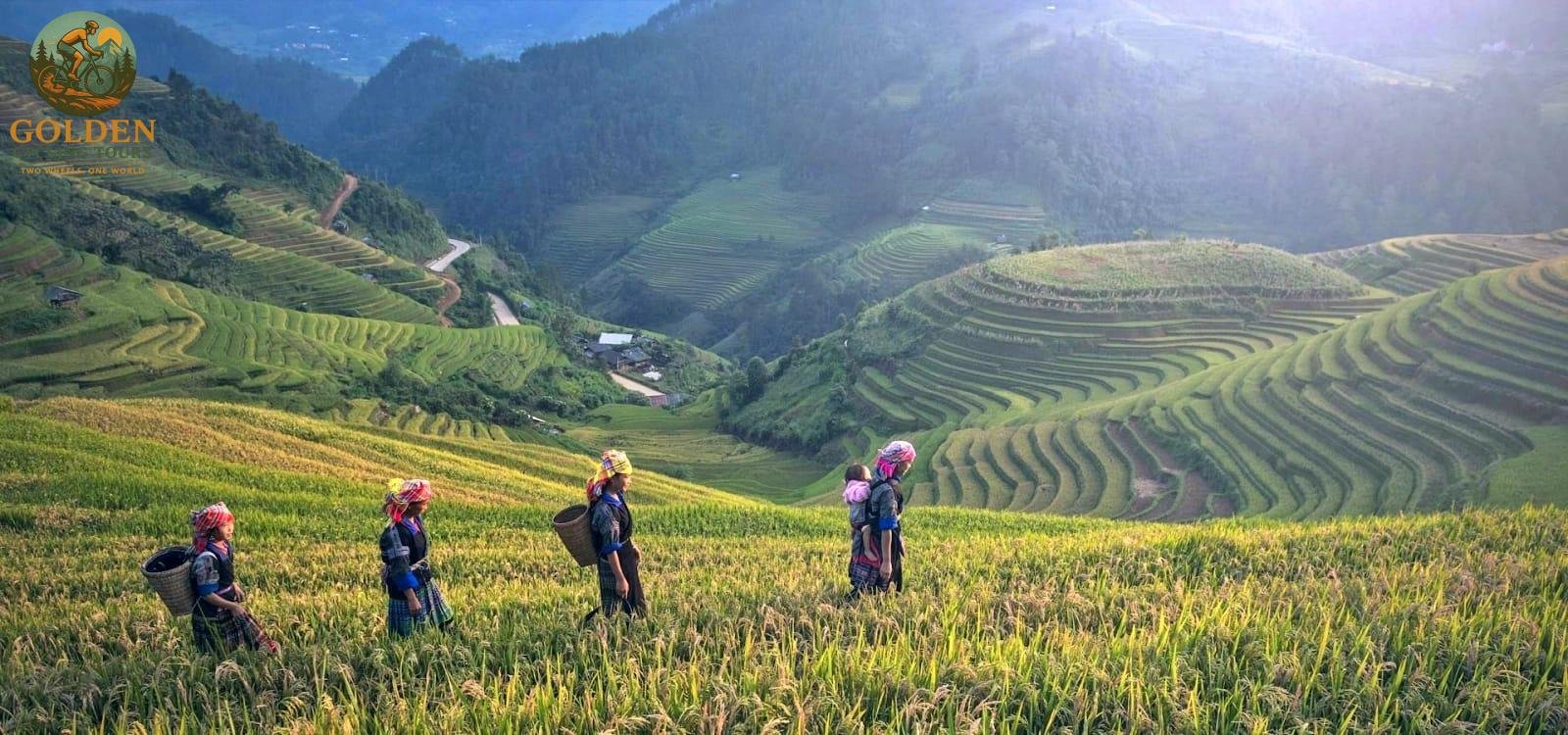
For international bikepackers, gravel cyclists, and endurance adventure travelers, conquering the northern frontier turns an ambitious mountain expedition into an effortless, life-changing journey. Carved high into the soaring flanks of the Hoang Lien Son Mountain Range and the sheer limestone spires of the far-north borderland, an ancient network of double-track forestry roads, hand-built concrete ramps, and crushed slate paths connects isolated Black H'Mong, Red Dao, Ha Nhi, Tay, and White Thai hamlets that remain completely untouched by mainstream tourism. At Golden Cycling Tours, we empower riders by providing high-spec gravel bike rentals, custom route planning, precision mechanical tuning, and dedicated support vehicles custom-fitted for rugged alpine terrain.
Traversing mountain passes exceeding 2,000 meters above sea level across Northern Vietnam requires balancing total riding freedom with realistic trail mechanics. Standard gravel setups designed for smooth rolling European dirt paths or flat American fire roads will quickly leave riders struggling on 18% village concrete climbs or sharp slate descents in remote nature reserves.
Riding gravel across this mountain sanctuary demands an appreciation for changing, technical trail conditions. A single day in the saddle transitions fluidly across four primary surfaces:
Raw Mountain Clay & Soil: Deep forestry tracks, red clay dikes, and singletracks cutting through protected zones like Che Tao Species and Habitat Conservation Area and Bat Xat Nature Reserve. When dry, these trails offer fast, tacky traction; when damp, they demand precise line selection and self-clearing tire tread patterns.
Eye-Watering Concrete Ramps: Hand-poured concrete tracks built to link remote mountain villages like Lim Mong Village, Lao Chai, Den Sang, and A Lu. These narrow paths feature steep gradients from 12% to over 20%, testing your climbing legs, traction control, and ultra-low gear ratios.
Crushed Slate & Loose Karst Gravel: Double-track logging backroads, dry riverbed stones, and hand-cut slate switchbacks snaking along high mountain passes like Khau Pha Pass, O Quy Ho Pass, and Ma Pi Leng Pass.
To explore this untamed terrain alongside veteran local ride leaders, discover our specialized Vietnam Northwest bike tours and multi-day cycling Northern Vietnam itineraries designed for passionate endurance riders.
Executing a successful expedition centered around Gravel Riding Northern Vietnam: Equipment, Tire Choice & Logistics requires meticulous component selection long before your wheels touch the trail.
Tires represent your single most critical contact point with the unpredictable mountain terrain of Lao Cai Province, Yen Bai Province, and Ha Giang Province.
Tire Width & Clearance: We strongly recommend tubeless knobby tires between 700x40c and 700x45c (or 650bx47c to 650bx50c). This volume provides essential dampening over crushed river rock while maintaining a solid contact patch on steep 18% concrete village ramps.
Tread Pattern: Choose a tire featuring dense center knobs for efficient rolling on tarmac valley connectors, flanked by aggressive shoulder knobs for cornering grip in damp red clay and loose slate.
Tubeless Setup & Sealant: Running tubeless is non-negotiable. High mountain backroads feature sharp limestone, thorn bushes, and rough concrete expansion seams. Ensure your setup includes fresh liquid sealant (at least 60 to 90ml per tire) and carry emergency tubeless tire plugs.
Pressure Calibration: Lower pressures (typically 24 to 30 PSI depending on rider weight and rim width) provide maximum traction on steep concrete climbs and damp clay while absorbing high-frequency vibrations from crushed river rock.
For riders who prefer high-performance machinery without the hassle of international bike transit, reserve custom-fitted gravel bikes or pedal-assist gravel e-bikes through our specialized Vietnam e-bike tours.
Standard gravel gearing (such as a 42T front ring paired with an 11-42T cassette) will burn out your legs on sustained mountain climbs.
Sub-1:1 Climbing Gear Ratios: A 1x drivetrain featuring a 38T or 40T chainring paired with a wide-range 10-44T, 10-50T, or 10-52T cassette yields a sub-1:1 gear ratio. This allows you to maintain a smooth 70+ RPM cadence on sustained vertical climbs through La Pan Tan Rice Terraces and Ngai Thau Peak.
Chain & Component Maintenance: Dust, crushed limestone, and wet mountain grit accelerate chain wear rapidly. Carry high-viscosity wet chain lubricant and apply it daily after cleaning your drivetrain.
Descending 15 to 20 kilometers continuously from high passes like O Quy Ho Pass demands unrelenting stopping power and thermal reliability.
Hydraulic Disc Brakes: Full hydraulic disc brakes are mandatory for single-finger lever control and hand fatigue reduction on technical descents. Cable-actuated mechanical disc brakes struggle under thermal stress on sustained 15% gradients.
Rotor Size & Pad Compounds: Upgrade to 160mm or 180mm rotors front and rear for effective heat dissipation. Metallic or semi-metallic brake pads handle wet grit and slate dust significantly better than organic pads. Always pack spare brake pads.
When riding deep inside conservation reserves, local mechanics in small hamlets only stock basic tools for light underbone motorbikes. Your bike setup must carry essential trailside tools:
Flare Handlebars & Thick Tape: Handlebars with 12° to 24° flare offer enhanced control when descending rough gravel in the drops. 3mm to 4mm shock-absorbing handlebar tape dampens wrist vibration over long riding days.
Trailside Tool Kit: Compact multi-tool with integrated chain breaker, spare chain quick-links, tubeless plug kit, mini hand pump, CO2 inflators, digital tire pressure gauge, spare derailleur hanger specific to your frame, and zip ties.
Executing seamless Gravel Riding Northern Vietnam: Equipment, Tire Choice & Logistics depends heavily on how your support logistics operate behind the scenes.
At Golden Cycling Tours, our full-support expeditions pair your ride with private, air-conditioned support vans fitted with custom padded bike racks:
Mobile Workshop & Luggage Transit: Support vehicles carry heavy luggage, bike flight cases, spare wheelsets, floor pumps, tools, medical first-aid kits, and fresh refreshments, keeping your gravel bike light and responsive on technical dirt switchbacks.
SAG Rides & Safety Net: Weather in high mountain passes can shift rapidly. If an unexpected mountain storm hits, or if legs burn out after consecutive days of 2,000-meter vertical climbing, cyclists can step into the private van at any point without sacrificing the route.
A well-crafted itinerary links the northern region's most magnificent geographic landscapes into an unforgettable off-road journey.
This legendary route launches from the warm agricultural basin of Tu Le Valley, leading riders up the eastern dirt backroads scaling Khau Pha Pass—one of the famed "Four Great Mountain Passes" of Vietnam. Cresting the summit reveals panoramic views over the world-famous La Pan Tan Rice Terraces and De Cu Nha.
Navigate flowing singletracks past landmark terraced formations like Raspberry Hill (Doi Mam Xoi) and Horseshoe Hill (Vanh Khung) before descending into Mu Cang Chai Town. Continuing north, high-altitude dirt tracks lead toward the alpine hub of Sapa, nestled beneath Fanxipan Peak, and across the dizzying drop-offs of O Quy Ho Pass.
If you wish to explore the alpine trails surrounding this mountain hub in detail, check out our dedicated Sapa bike tours.
For riders who thrive on sharp limestone karst spires, Ha Giang Province presents unyielding gravel routes across the UNESCO-listed Dong Van Karst Plateau. Navigate hand-carved stone paths and steep concrete switchbacks along the backroads of Ma Pi Leng Pass, looking down into the deep turquoise canyon of the Nho Que River.
Explore these rugged northern loops on our dedicated Ha Giang bike tours.
Perched at over 1,800 meters elevation in Lao Cai Province along the international border, Y Ty offers an otherworldly gravel setting. Ridge tracks leading through A Lu and Ngai Thau Peak float directly over vast oceans of white cloud beneath the peaks of Ky Quan San (Bach Moc Luong Tu).
The eastern frontier features rolling karst valleys, bamboo groves, and ancient trading paths. Cyclists explore remote dirt tracks around Cao Bang, leading toward the roaring cascades of Ban Gioc Waterfall. Nearby, the highland market town of Bac Ha offers vibrant cultural encounters combined with punchy mountain dirt loops.
Plan your eastern expedition with our Cao Bang bike tours, Bac Ha bike tours, and Vietnam Northeast bike tours.
Before tackling high mountain passes, low-elevation karst valleys provide the ideal warm-up terrain to test your bike configuration. Riders spin along peaceful dirt dikes, emerald riverbanks, and cave entrances in Ninh Binh, or weave through bamboo forests and serene stilt-house villages across Mai Chau and Pu Luong Nature Reserve.
Warm up your legs on our guided Ninh Binh bike tours, Mai Chau bike tours, and Pu Luong bike tours.
Timing your gravel expedition accurately ensures manageable dirt trail traction and jaw-dropping visual backdrops.
Late September through October represents the undisputed golden hour for gravel biking in Northern Vietnam. During these autumn weeks, the terraced valleys of Mu Cang Chai, Sapa, Bat Xat, and Y Ty erupt into a brilliant sea of yellow as rice crops mature simultaneously.
The climate is dry, crisp, and perfectly tailored for sustained climbing, with daytime temperatures hovering between 18°C and 24°C. The warm aroma of ripe grain mixes with the earthy scent of crushed soil as you spin along sunlit ridges.
From November through April, high-altitude hubs like Y Ty transform into premier cloud-hunting havens. Temperature inversions trap thick oceans of fog in the valleys below, allowing cyclists to ride along sunlit dirt ridges floating above a white sea. Mid-winter (December to January) brings cold polar surges with crisp frost and rare light snowfall to high passes like O Quy Ho Pass.
The water-pouring season (Mua Nuoc Do) occurs between May and June when early summer rains fill the terraced steps. Mountain slopes transform into thousands of shimmering glass mirrors reflecting the open sky. While wet mountain clay requires precise bike handling, the visual reward is extraordinary.
From January to March, spring brings crisp alpine breezes, blooming white plum orchards, and pink peach blossoms across remote villages. Morning mists drift softly across mountain summits, surrounding your ride in a quiet, ethereal atmosphere.
Riding remote mountain backroads opens a rare door into the ancient heritage of Northern Vietnam's ethnic minority communities.
The high mountain ridges are home to the Black H'Mong, Red Dao, and Ha Nhi ethnic groups, while lush valley floors are settled by the Tay and White Thai people. When biking through working hamlets like Lim Thai Village, Zeu Rai, Ta Van, or A Lu, respect local customs:
Always ask for permission before taking photographs of villagers or inside homes.
Remove your shoes when entering ethnic minority stilt houses or rammed-earth dwellings (Nha Trinh Tuong).
Do not touch sacred altars located inside traditional family homes.
Learn simple greetings in Vietnamese (Xin Chao) or H'Mong (Cua Dua) to build instant warm connections with local children and elders.
High-altitude cross-country riding burns immense energy, and the organic cuisine of Northern Vietnam provides the ultimate fuel for muscle recovery.
Xoi Tu Le (Tu Le Sticky Rice): Sweet, fragrant glutinous rice cooked inside bamboo shafts, served alongside savory grilled mountain pork skewers.
Thit Lon Cap Nach (Free-range Hill Pork): Marinated with wild mountain pepper (Mac Khen) and slow-roasted over charcoals until juicy and crisp.
Lau Ca Hoi Sapa (Sapa Salmon Hotpot): Fresh mountain salmon cooked in an aromatic broth loaded with wild forest herbs, bamboo shoots, and fresh greens.
Ga Doi (Mountain Free-Range Chicken): Lean hill chicken marinated with wild forest honey, grilled over open flames, and served with chili-lime salt.
Pa Pinh Top: Authentic Thai river fish filled with fresh lemongrass, garlic, mint, and aromatic forest spices, then grilled over hot embers.
Shan Tuyet Tea: Brewed from ancient tea trees growing high in the misty peaks of Y Ty and Mu Cang Chai, offering a bittersweet flavor that revitalizes tired legs.
Restful sleep is vital when tackling consecutive high-elevation riding days. Accommodations are selected to match your personal travel style:
Traditional Ethnic Homestays: Experience authentic hospitality in wooden stilt houses or rammed-earth homes in Y Ty, Tu Le, or Mu Cang Chai, complete with home-cooked family feasts and steaming herbal foot baths infused with forest leaves.
Mountain Eco-Lodges: Perched on scenic hilltops overlooking terraced fields in Ta Van or Y Ty, offering private wooden bungalows, hot showers, infinity pools, and local dining.
Luxury Mountain Resorts: High-end boutique accommodations in Sapa like Hotel de la Coupole or Topas Ecolodge, accessible through our curated Vietnam luxury bike tours.
Every high-altitude gravel expedition into the northern mountains originates from the vibrant capital of Hanoi. Organizing smooth transit for yourself and your bicycle equipment sets a positive tone for the entire trip.
Support Vans & Private Limousines: Air-conditioned limousines and private support vans equipped with custom bike racks operate daily via modern expressways connecting Hanoi directly to Nghia Lo, Sapa, Ha Giang, or Cao Bang.
Before launching into the high peaks, many independent riders begin their journey with our guided urban Hanoi bike tours.
If your passion for off-road riding extends beyond the northern mountains, Vietnam offers an endless matrix of breathtaking routes stretching down to tropical coasts and historic jungle trails.
You can combine your mountain journey with historic supply routes on our Ho Chi Minh Trail cycling tours, explore ocean vistas on our Vietnam coastal cycling tours, take on our popular 15 days Hanoi to Hue coastal cycling tour, or embark on the grand cross-country cycling North to South Vietnam expedition.
"Mastering Gravel Riding Northern Vietnam: Equipment, Tire Choice & Logistics with Golden Cycling Tours was the absolute trip of a lifetime. Following their advice on tubeless 700x42c tires and sub-1:1 climbing gearing made scaling Khau Pha Pass backroads a dream!"
"As an experienced bikepacker, I was impressed by the technical mechanics and logistics backing provided by Golden Cycling Tours. Riding remote dirt trails through Bat Xat Nature Reserve and Y Ty was seamless, and having the support van nearby gave total peace of mind."
We recommend tubeless knobby tires between 700x40c and 700x45c. This width provides adequate cushioning over crushed slate while maintaining traction on steep concrete village ramps.
A 1:1 or sub-1:1 climbing gear ratio is strongly recommended (e.g., a 38T or 40T front ring paired with a 10-44T or 10-52T rear cassette) to navigate gradients reaching 15% to 20%.
Yes! Golden Cycling Tours supplies high-quality, fully serviced gravel bikes, hardtail mountain bikes, and pedal-assist gravel e-bikes fitted precisely to your measurements and gearing preferences.
Yes. Wet mountain grit accelerates brake pad wear on long descents, and derailleur hangers are specific to each frame brand, making local replacements in remote hamlets impossible to find.

.jpg "Thai Binh Vietnam Bicycle")
.jpg "Phu Tho Vietnam Cycling")
.jpg "Thai Nguyen Cycling Vietnam")
.jpg "Tuyen Quang Cycling Vietnam")
.jpg "Vinh Phuc Cycling Vietnam")
Leave a Reply
Your email address will not be published. Required fields are marked *