- Call us Via Whatsapp: +84 (0) 832 126 699
4.9 stars on our site
(15,000 reviews)
- Monday - Sunday : 08:00 - 17:00
(15,000 reviews)

E-Bike vs Regular Bike for Biking Northern Vietnam: Full Comparison is the ultimate guide for travelers weighing whether to tackle Southeast Asia's most dramatic mountain circuits using traditional muscle power or modern electric pedal-assist technology. Northern Vietnam presents legendary vertical landscapes where towering limestone monoliths, roaring borderland rivers, and ancient mountain passes call out to intrepid adventurers. Deciding between an e-bike and a standard road or mountain bicycle transforms your journey's pace, physical demand, and daily scenery. Partnering with Golden Cycling Tours gives you access to expertly curated itineraries, premium fleets, and top-tier support across world-class Vietnam e-bike tours and Vietnam luxury bike tours.
Dawn crests over the northern highland ridges with a cool, damp mist clinging softly to high-altitude pine forests, bamboo thickets, and deep mountain basins. The crisp mountain air carries the invigorating aromas of wet loam, wild star anise, cardamom, and aromatic woodsmoke drifting softly from timber stilt hamlets. As your shoes lock into the pedals and your crank begins to spin, the satisfying mechanical click-clack of your rear cassette gear shift echoes against vertical granite cliffs. On an e-bike, the whisper-quiet electric motor engages with an empowering surge, while on a regular bike, your leg muscles flex in raw, rhythmic cadence.
Riding through the northern mountain ranges elevates a journey into a pure sensory celebration. You feel the cool mountain breeze brushing against your face as you climb toward the clouds, your lungs expanding with pristine alpine air. Below your tires, wide rubber treads grip smooth tarmac and rustic backcountry gravel with reassuring traction, creating a soothing rhythm as panoramic vistas unfold around every hairpin turn.
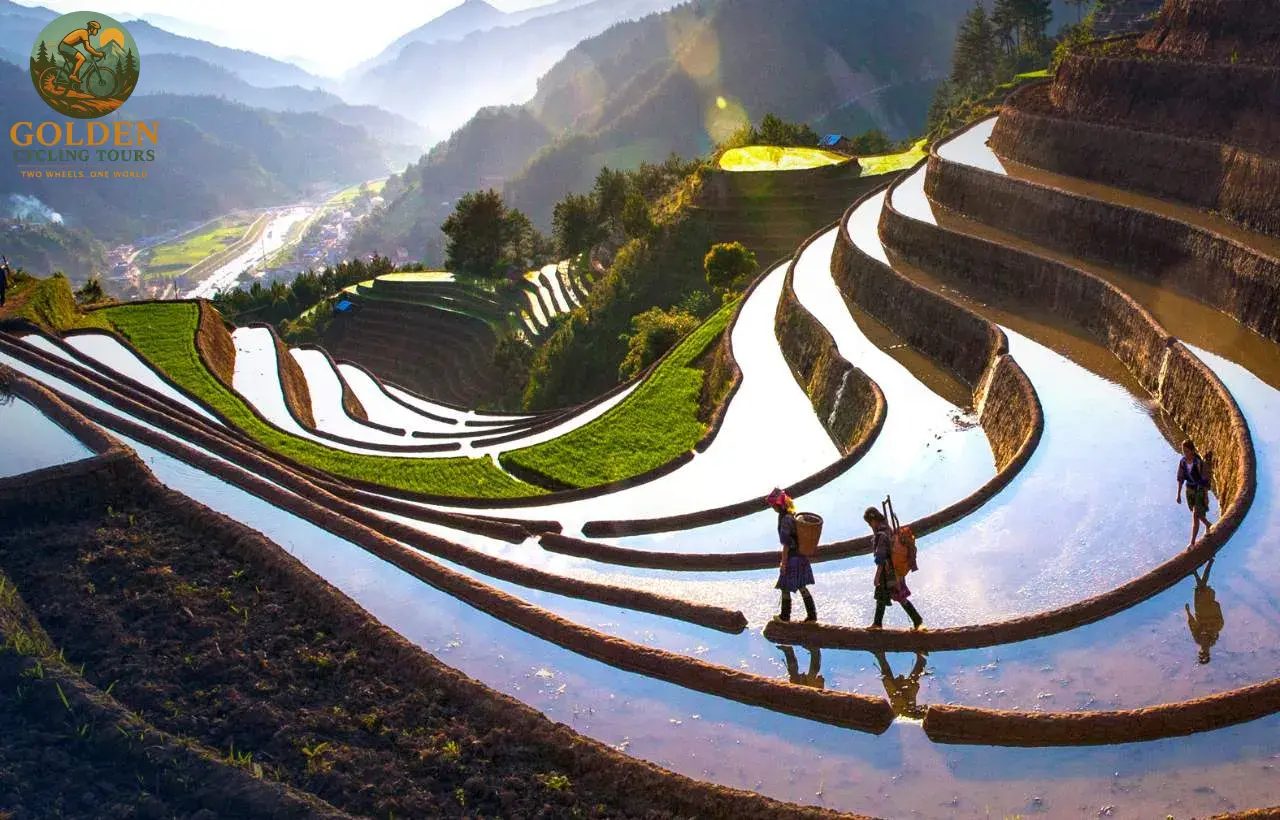
Around every bend, nature reveals breathtaking sights: dark limestone needles piercing cloud-swept skies, golden rice terraces cascading thousands of feet into emerald river basins, and turquoise rivers winding through deep canyons. Whether navigating steep climbs on a standard road bike or effortlessly gliding uphill with electric power, you are not watching the scenery from behind a tour bus window; you are completely immersed within the landscape, breathing its wild scents and greeting local villagers with warm smiles along the way.
Choosing the right two-wheeled vehicle for an expedition through Northern Vietnam depends on your physical conditioning, your preferred daily mileage, and the kind of experience you want to have in the mountains. Here is how both options compare across key factors:
Conquering iconic mountain passes like Ma Pi Leng Pass or O Quy Ho Pass on a standard regular bicycle demands significant physical endurance, strong cardiovascular conditioning, and dedicated stamina for sustained 8% to 12% gradients. For experienced endurance cyclists, the intense physical exertion and muscle burn bring a deep sense of athletic accomplishment when reaching the summit.
Conversely, an electric pedal-assist bicycle flattens steep gradients with customizable motor torque. Rather than gasping for air on steep switchbacks, e-bike riders maintain a relaxed pedal cadence and a steady heart rate. This allows you to climb thousands of vertical feet effortlessly, preserving your energy to enjoy the mountain scenery and explore roadside hamlets.
On a regular touring bicycle, daily riding distances in heavy alpine terrain typically range between 40 to 60 kilometers before physical fatigue sets in. Unexpected head winds, gravel track sections, or prolonged climbs can slow momentum and dictate early stops.
E-bikes extend your daily range to 70 to 100 kilometers across rugged terrain without physical exhaustion. With motor assistance carrying you up steep ascents, you can explore hidden side valleys, visit remote ethnic hamlets, and reach distant viewpoints that might otherwise be omitted from a standard cycling itinerary due to time or stamina constraints.
Both options offer intimate, open-air travel that far surpasses vehicle travel, but they shape your village interactions differently. On a traditional bicycle, frequent rest breaks allow for spontaneous stops at mountain tea stalls and roadside water springs, where locals often admire your athletic effort.
E-bikes travel silently and allow you to arrive at high mountain hamlets feeling fresh and energized. Because you are not physically exhausted after a long climb, you have plenty of energy to stroll through weekend markets, participate in village textile weaving demonstrations, and converse with local hosts at evening homestays.
A regular bicycle tour requires participants to have similar fitness levels to maintain a cohesive group pace. Varying fitness levels can cause groups to stretch out across long mountain ascents, leading to longer wait times at pass summits.
E-bikes act as an equalizer for couples, families, and mixed-ability groups. A novice rider or an older cyclist using high pedal-assist can easily ride alongside an experienced cyclist using low assist, keeping everyone together to share every summit view and tea break as a group.
The famous Dong Van Karst Plateau Geopark represents Vietnam's ultimate alpine cycling frontier. On an e-bike or traditional bicycle, conquering the switchbacks of Tham Ma Pass and climbing to Quan Ba Heaven's Gate offers thrilling mountain vistas. Hover above the abyss of Tu San Canyon as you cross Ma Pi Leng Pass, looking down at the jade ribbon of the Nho Que River. Explore cultural landmarks including the historic H'Mong King Palace and reach the northernmost frontier point at the Lung Cu Flag Tower. Complete your loop by relaxing near the waterfalls of Du Gia National Park.
Nestled under the shadow of Fansipan Peak, the alpine town of Sapa offers world-class mountain views. Electric pedal-assist enables cyclists of all fitness levels to conquer O Quy Ho Pass—the longest mountain pass in Vietnam—without physical exhaustion, while traditional cyclists test their endurance against its high-altitude ascents. Glide along ridges overlooking the emerald steps of Muong Hoa Valley, where ancient stone carvings lie nestled among misty hillsides.
Venture east into the vast Cao Bang UNESCO Global Geopark, a realm of emerald river basins and limestone towers. The crown jewel of the region is Ban Gioc Waterfall, a roaring multi-tiered cascade framing the international border along the Quay Son River. Ride along shaded riverbanks, explore the vast chambers of Nguom Ngao Cave, reflect at the Thang Hen Lake System, and cycle along peaceful forest trails to Lenin Stream inside the historic Pac Bo Historic Site. Conquer rolling mountain slopes across Ma Phuc Pass and Khau Lieu Pass while taking in sweeping valley views.
For gentle, scenic riding through peaceful countryside, the serene basin of Mai Chau Valley offers flat paths flanked by emerald rice fields and traditional wooden stilt houses. Extend your ride into Pu Luong Nature Reserve, pedaling along narrow jungle trails where ancient bamboo waterwheels scoop cool water from rushing mountain streams beneath Pha Luong Peak.
Known as Halong Bay on land, Ninh Binh showcases towering karst formations rising from lotus waterways. Cycle through the UNESCO-listed Trang An Scenic Landscape Complex, pedal beside the riverways of Tam Coc, and ride beneath ancient jungle canopies within Cuc Phuong National Park.
Every northern expedition begins or finishes in the vibrant capital of Hanoi. Cycle along wide tree-lined boulevards surrounding Hoan Kiem Lake, navigate the ancient trade alleys of the Hanoi Old Quarter, and pedal across historic iron bridges spanning the Red River Delta.
Northern Vietnam is home to over thirty distinct ethnic minority communities, including the H'Mong, Red Dao, Tay, Nung, Muong, Giay, and Black Lolo peoples. Traveling on two wheels creates an open, respectful bridge between visitors and local mountain villages.
Silent electric motors and bicycles allow travelers to enter quiet hamlets without disturbing the rhythm of rural life. Pause to watch H'Mong women transform raw hemp into vibrant indigo textiles at the Lung Tam Linen Fabric Weaving Village, or observe ancestral forging techniques at Phuc Sen Blacksmith Village. Experience vibrant weekend trade gatherings like Dong Van Market, Meo Vac Market, and Bac Ha Market, where villagers dressed in elaborate hand-woven textiles gather to trade mountain honey, forest produce, and livestock.
Cycling through crisp mountain air awakens a robust appetite, and Northern Vietnam’s regional cuisine is hearty, aromatic, and deeply tied to the terrain.
Thang Co: A traditional H'Mong broth seasoned with star anise, cardamom, lemongrass, and mountain pepper berries, simmered slowly over open wood fires.
Vit Quay 7 Vi (Seven-Flavor Roasted Duck): Succulent Cao Bang duck marinated in seven indigenous forest spices, slow-roasted over charcoal until the skin turns crispy and golden.
Thit Trau Gac Bep: Highland buffalo meat cured over kitchen hearth smoke and seasoned with wild mac khen pepper and chili.
Banh Cuon Cao Bang: Delicate, freshly steamed rice rolls filled with seasoned pork and served floating in savory bone broth with mountain herbs.
Com Lam & Xoi Ngu Sac: Fragrant glutinous rice cooked inside bamboo tubes, alongside Five-Color Sticky Rice naturally dyed using local forest leaves.
Banh Tam Giac Mach: Soft, earthy cakes made from ground buckwheat seeds harvested from mountain stone terraces.
Shan Tuyet Tea & Corn Wine: Refreshing herbal tea brewed from century-old wild tea trees growing in the fog of Tay Con Linh Mountain, and smooth corn spirits distilled with traditional herbal yeast.
Northern Vietnam provides a versatile range of accommodations blending regional charm with modern comfort:
Ha Giang & Quan Ba: Experience authentic Red Dao hospitality at Nam Dam Dao Lodge in Nam Dam Village, built using traditional rammed-earth techniques, or enjoy boutique luxury at Panhou Retreat near Hoang Su Phi. In Meo Vac, rest inside restored stone heritage fortresses like Auberge de Meo Vac.
Sapa & Topas Ecolodge: Stay in luxury stone chalets perched high atop mountain ridges at Topas Ecolodge, featuring panoramic views over deep valleys.
Mai Chau & Pu Luong: Unwind in elevated timber stilt houses at Mai Chau Ecolodge or Pu Luong Retreat, where private infinity pools overlook cascading rice terraces.
Cao Bang & Ban Gioc: Rest at eco-focused retreats along the Quay Son River like Sa's Home or Kolorado Retreat Ban Gioc in Kieu Chanh Village, or enjoy Tay ethnic stilt houses near Ba Be Lake inside Ba Be National Park.
Hanoi & Ninh Binh: Choose high-end city sanctuary at Muong Thanh Luxury Cao Bang Hotel or luxury eco-resorts nestled amidst the limestone karsts of Trang An Scenic Landscape Complex.
Reaching northern mountain starting points from Hanoi is comfortable and efficient:
VIP Sleeper Bus: Direct night buses depart Hanoi daily for Ha Giang, Sapa, and Cao Bang, featuring private lie-flat sleeping cabins so you arrive well-rested at the base of the mountains.
Luxury Limousine Vans: High-end 9-seater passenger vans provide comfortable daytime transfers directly from your Hanoi hotel to Mai Chau, Pu Luong, or Ninh Binh.
All-Inclusive Private Support: Booking a fully guided tour with Golden Cycling Tours includes dedicated high-roof support vehicles that transport luggage, carry spare fully charged e-bike batteries, handle technical maintenance, and provide comfortable passenger transport whenever you want a break.
Autumn (September to November) - Peak Season: Ideal riding weather with dry, sunny skies and comfortable high-altitude temperatures. Terraced rice fields in Hoang Su Phi, Sapa, and Mu Cang Chai turn glowing golden, while Ban Gioc Waterfall flows in full volume.
Spring (February to April): Lush green foliage, blooming pink peach blossoms, and white plum flowers blanket mountain slopes, creating a vibrant spring setting for cycling.
Winter (December to January): Crisp, cool mountain air creates energized riding conditions, perfect for conquering mountain passes like O Quy Ho Pass and Ma Pi Leng Pass without heat. Late autumn also marks the Buckwheat Flower Season (Hoa Tam Giac Mach), turning karst valleys soft shades of pink and purple.
Summer (May to August): The water-pouring season (Mua Nuoc Do) fills terraced fields with sky reflections, while rivers and waterfalls roar amidst tropical greenery.
"Deciding on an e-bike for our northern mountain tour was the best choice we made. We completed an E-Bike vs Regular Bike for Biking Northern Vietnam: Full Comparison assessment beforehand, and having pedal-assist up Ma Pi Leng Pass allowed us to enjoy every moment without physical strain!" — David & Emma Watson, United Kingdom
"The Bosch pedal-assist e-bikes provided by Golden Cycling Tours were fantastic. Climbing steep passes felt smooth, the Tay homestays were welcoming, and the support van was always nearby whenever we needed a drink or a break." — Michael Schmidt, Germany
Discover a complete collection of handcrafted cycling itineraries designed by Golden Cycling Tours:
Begin your journey with urban exploration on Hanoi bike tours, ride between karst towers on Ninh Binh bike tours, or cycle through peaceful bamboo valleys on Mai Chau bike tours and Pu Luong bike tours.
Conquer famous mountain heights on Sapa bike tours, experience tribal heritage on Bac Ha bike tours, explore borderland waterfalls on Cao Bang bike tours, or take on iconic mountain loops on Ha Giang bike tours.
For multi-region journeys, explore custom itineraries across Vietnam Northwest bike tours, breathtaking coastal karst loops via Vietnam Northeast bike tours, multi-week mountain routes on cycling Northern Vietnam, epic cross-country expeditions like cycling North to South Vietnam, high-end tailored trips on vietnam luxury bike tours, historic rides along Ho Chi Minh Trail cycling tours, and premium fleet selections on vietnam e-bikes tours.
If you are an experienced endurance cyclist who enjoys high physical challenge, a regular bike offers a rewarding workout. If you prefer to conquer steep ascents like Ma Pi Leng Pass comfortably without exhaustion, an e-bike provides motor assistance that makes mountain climbing accessible and enjoyable.
Modern lithium e-bike batteries last between 60 to 90 kilometers on a single charge in mountain terrain. On guided tours with Golden Cycling Tours, support vehicles carry fully charged spare batteries to ensure uninterrupted riding all day.
Yes. E-bikes allow riders of varying fitness levels to travel together at a comfortable group pace, making them ideal for couples, families, and friends with differing cycling experience.
Pack breathable cycling wear, padded bike shorts, a lightweight windbreaker or rain jacket, comfortable closed-toe riding shoes, sun protection, and a warm fleece layer for cool mountain evenings.

.jpg "Thai Binh Vietnam Bicycle")
.jpg "Phu Tho Vietnam Cycling")
.jpg "Thai Nguyen Cycling Vietnam")
.jpg "Tuyen Quang Cycling Vietnam")
.jpg "Vinh Phuc Cycling Vietnam")
Leave a Reply
Your email address will not be published. Required fields are marked *