- Call us Via Whatsapp: +84 (0) 832 126 699
4.9 stars on our site
(15,000 reviews)
- Monday - Sunday : 08:00 - 17:00
(15,000 reviews)

Imagine standing at the edge of the Earth, where razor-sharp limestone pinnacles slice through oceans of morning mist, and the sharp scent of mountain pine mingles with the earthy fragrance of wild buckwheat. As you click your cleats into the pedals, the cold mountain air fills your lungs, and the silent valley below awakens to the distant clatter of wooden waterwheels. This is Vietnam’s final frontier. Biking the Ha Giang Loop: The Ultimate Cycling Itinerary is not merely a journey across geographical coordinates; it is a visceral, multi-sensory odyssey that demands every ounce of your physical energy while granting pure adrenaline, breathtaking visual awe, and deep spiritual reward in return.
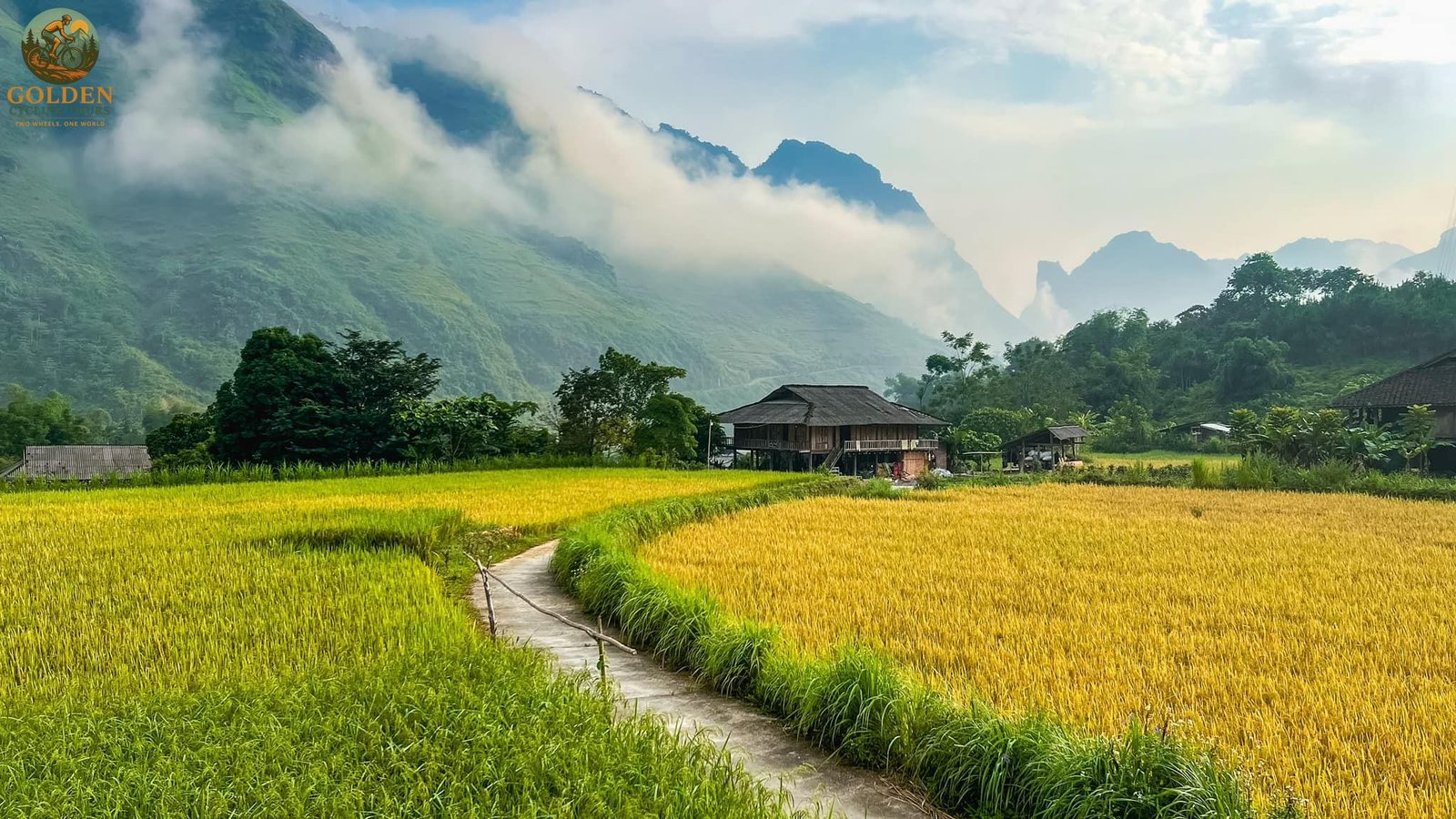
For passionate cyclists, navigating this legendary northern circuit is the ultimate bucket-list adventure. While many travelers zip past on noisy motorbikes, tackling the terrain on two human-powered wheels—or assisted by high-end electric bicycles—allows you to feel every gradient, taste the crisp mountain mist, hear the rhythmic clicking of your cassette on endless switchbacks, and connect intimately with the warm-hearted hill tribes who call these vertical landscapes home.
Whether you are looking to conquer steep alpine climbs or glide along river canyons, Golden Cycling Tours provides fully supported expeditions that turn this dream into a seamless reality.
To pedal through Ha Giang is to immerse yourself in a symphony of sensory highlights:
The tactile bite of cool granite dust as you rest your hand against a roadside cliff after a grueling hairpin climb.
The intoxicating aroma of roasted corn, woodsmoke, and wild mountain herbs drifting from timber stilt houses perched precariously over deep chasms.
The thunderous silence of deep mountain gorges, broken only by the hum of your tires on fresh asphalt and the cheerful shouts of ethnic children calling out "Hello!" from emerald rice terraces.
The visual feast of jagged karst formations stretching endlessly toward the horizon, painted in rich greens, earthy terracottas, and seasonal blooms of pink buckwheat flowers.
The rich taste of homemade corn wine (Ruou Ngo) warming your throat at night in a traditional ethnic homestay after a satisfying 70-kilometer ride.
Unlike motorized travel, cycling matches the heartbeat of the mountains. You setting your own rhythm gives you the freedom to pause whenever a hidden waterfall reveals itself or when a colorful local market invites you to sample fresh mountain delicacies.
Timing is everything when planning your cycling expedition through northern Vietnam. The weather dictates road conditions, mountain visibility, and the natural colors of the landscape.
Autumn is widely considered the absolute prime time for cycling in Ha Giang. The heavy summer rains have subsided, leaving behind cool, crisp air with temperatures ranging from 15°C to 24°C (59°F–75°F). September brings golden yellow rice terraces harvested across Dong Van Karst Plateau Geopark, while October and November blanket the valleys in pink and white buckwheat blossoms (Hoa Tam Giac Manh). Crisp morning skies ensure clear views across mountain passes.
Spring brings rebirth to the high rocky plateaus. As winter's deep chill fades, peach trees burst into soft pink blossoms, and plum trees cover valleys like Sung La Valley in pure white petals. Temperatures are pleasant for long days in the saddle, hovering around 18°C to 26°C (64°F–79°F). Days are generally dry, offering comfortable riding conditions across high-altitude trails.
Winter brings dramatic mist, freezing temperatures on high passes like Ma Pi Leng Pass, and occasionally frost on the highest peaks. While cycling in winter requires warm layer systems and thermal cycling apparel, the surreal atmosphere of limestone towers piercing thick banks of cloud provides an ethereal experience for hardier riders.
Summer brings lush vegetation and overflowing rivers. However, it is also the monsoon season, bringing sudden heavy downpours, high humidity, and occasional landslide risks on remote mountain passes. For most cyclists, autumn and spring offer the safest and most pleasurable conditions.
This carefully curated 5-day cycling itinerary balances epic climbs, thrilling descents, cultural immersions, and adequate recovery time. Engineered by the experts at Golden Cycling Tours, it represents the definitive guide to mastering the loop.
Cycling Distance: Approximately 52 km
Total Elevation Gain: ~1,250 m
Terrain: Asphalt roads, long sustained mountain ascents, technical switchbacks
Your journey begins in Ha Giang City, the gateway where urban flatlands dissolve into towering limestone walls. After a bike fitting and briefing with your support crew, your pedals turn northward along Route QL4C.
The real test begins as you tackle Bac Sum Pass, a serpent-like mountain road that weaves upward through dense greenery. Your quads will burn as you conquer gradient after gradient, but the reward at the summit is immediate. You reach Quan Ba Heaven Gate (Cong Troi Quan Ba), perched over 1,500 meters above sea level. Here, cool air greets your sweating face as you gaze down upon the breathtaking Twin Mountains (Nui Doi Quan Ba or Fairy Breast Mountains) rising gracefully from emerald valley floors.
A thrilling descent brings you into Quan Ba District, where you will settle into a charming Tay or H'Mong homestay, enjoying fresh organic vegetables and crisp mountain air.
Cycling Distance: Approximately 80 km
Total Elevation Gain: ~1,650 m
Terrain: High-altitude mountain passes, undulating rocky roads, scenic descents
Awake to the sound of roosters and mountain bird calls. Today takes you deep into the heart of the UNESCO-recognized Dong Van Karst Plateau Geopark.
The morning ride features the legendary Tham Ma Pass, an iconic S-shaped road carved directly into the mountain face. Cyclists love testing their cadence on these smooth, sweeping turns while taking in views of terraced cornfields clinging to sheer rock cliffs. Continuing past Chin Khoanh Pass, you enter Sung La Valley, famed as the filming location for "Pao's Story" and renowned for its ancient mud-walled houses with dark clay tiled roofs.
Before arriving in the historical town of Dong Van, you will detour to visit the H'Mong King Palace (Dinh Nguyen Vuong) in Sa Phin Valley. Built over a century ago with intricate stone carving, wood craftsmanship, and Chinese-European fusion architecture, this fortress offers a fascinating window into the region's royal feudal past. End the day in Dong Van Old Quarter, sipping local drip coffee alongside historic stone buildings built in the early 20th century.
Cycling Distance: Approximately 65 km
Total Elevation Gain: ~1,400 m
Terrain: Cliffside narrow roads, steep ascents, dramatic canyon descents
This is the crown jewel day of your expedition. You begin with an early morning ride to Lung Cu Flag Tower, the official northernmost point of Vietnam bordering China. Standing high atop Dragon Mountain (Nui Rong), looking down at the giant national flag flapping in the mountain breeze, fills every traveler with awe.
Rejoining the main route, you encounter the king of all Vietnamese mountain passes: Ma Pi Leng Pass. Hanging suspended on a narrow cliff-edge road carved into vertical mountain faces, this 20-kilometer pass overlooks the emerald-green Nho Que River winding thousands of meters down through Tu San Canyon—the deepest canyon in Southeast Asia.
The feeling of cycling along Ma Pi Leng Pass is indescribable: the wind humming in your helmet, the sheer drop-off to your right, and raw limestone peaks stretching as far as the eye can see. Stop at panoramic viewpoints to catch your breath, take photos, and absorb the sheer majesty of Northern Vietnam before enjoying a winding descent into Meo Vac Town.
Cycling Distance: Approximately 73 km
Total Elevation Gain: ~1,100 m
Terrain: Rural mountain routes, mix of smooth asphalt and rough concrete, quiet rural valleys
Leaving Meo Vac, you turn off the main tourist trail onto quieter backroads winding toward Du Gia Village. Today's ride takes you through some of the most serene and unspoiled landscapes in the province.
You will pedal through Mieu Vac Valley and over mountain passes where local ethnic children tend to buffaloes alongside quiet cornfields. The scent of wild flora fills the air, and the lack of vehicular traffic makes this segment a pure cycling joy.
Arriving in Du Gia Village—a picturesque enclave surrounded by emerald rice fields and inhabited by the Tay ethnic group—you can cool down with a dip in the crystal-clear waters of Du Gia Waterfall. Enjoy an evening of traditional folk singing, grilled meats, and local hospitality at a stilt-house lodge.
Cycling Distance: Approximately 75 km
Total Elevation Gain: ~900 m
Terrain: River valley descents, rolling hills, flat finish
Your final leg brings you back toward the lowlands. The route leaves Du Gia and follows rural rivers through Thai An Pass and Mien River Basin. While there are still moderate ascents to conquer, much of the day consists of long, flowing descents where you can soak in the final views of towering limestone peaks softening into lush green bamboo forests.
Reaching Ha Giang City in the late afternoon marks the completion of your epic loop. As you unclip from your pedals and celebrate with your fellow riders, you will carry memories of triumph, incredible scenery, and deep cultural warmth that few other journeys on Earth can rival.
What transforms Biking the Ha Giang Loop: The Ultimate Cycling Itinerary into a deeply moving life experience is the opportunity to interact with over 17 distinct ethnic minority groups who inhabit these highlands, including the H'Mong, Tay, Dao, Nung, and Lolo peoples.
If your riding schedule aligns with the weekend, visiting a local market is essential. The Dong Van Market, Meo Vac Market, and Quan Ba Market transform quiet towns into vibrant spectacles of color every Sunday morning. Women dressed in handmade indigo-dyed dresses with woven silver jewelry trade textiles, livestock, fresh spices, and handmade tools.
Along the route, you will observe unique architectural styles adapted to extreme terrain:
H'Mong earthen-walled houses (Nha Trinh Tuong) constructed from compacted clay without mortar, keeping interiors warm in winter and cool in summer.
Tay wooden stilt houses (Nha San) built on tall timber pillars along riverbanks and valley floors.
Respecting local customs—such as asking permission before taking portraits, removing shoes when entering private homes, and supporting local artisan cooperatives—ensures your visit positively impacts these mountain communities.
Cycling burns thousands of calories per day, making mountain cuisine both essential fuel and an exciting culinary discovery.
Thang Co: A traditional H'Mong horse meat and organ stew seasoned with wild mountain cardamoms, cinnamon, lemongrass, and star anise.
Smoked Buffalo Meat (Thit Trau Gac Bep): Strips of fresh buffalo meat marinated in wild pepper (Mac Khen) and chili, then hung above kitchen wood fires for months until rich, savory, and chewy.
Five-Color Sticky Rice (Xoi Ngu Sac): Glutinous rice colored naturally using forest leaves, berries, and roots, symbolizing the five elements of nature.
Buckwheat Cakes (Banh Tam Giac Manh): Soft, earthy cakes made from harvested buckwheat seeds, steamed in molds, and lightly grilled over hot charcoal.
Men Men: Steamed corn meal, the staple food of the H'Mong people residing in high rocky areas where wet rice cannot grow.
In Ha Giang City: Local eateries along Nguyen Trãi Street serving hot Banh Cuon (steamed rice rolls) filled with minced pork and wood-ear mushrooms served in warm seasoned bone broth.
In Quan Ba & Yen Minh: Family-run roadside restaurants serving stir-fried wild boar with jungle herbs and fresh river bamboo shoots.
In Dong Van Old Quarter: Charming courtyard cafes serving traditional egg coffee alongside small family bistros offering steaming hot pots (Lau) packed with mountain vegetables, black chicken, and local mushrooms.
In Homestays: Home-cooked family-style dinners prepared by your hosts, featuring free-range chicken, mountain herbs, crisp fried spring rolls, and fragrant local sticky rice.
Restful sleep is vital when tackling mountain elevation profiles day after day. Ha Giang offers options ranging from authentic cultural homestays to boutique eco-lodges.
Staying in a community homestay in Du Gia Village, Lolo Chai Village (near Lung Cu Flag Tower), or Nham La offers unmatched hospitality. Sleeping in clean, private curtained rooms inside traditional timber stilt houses gives you a direct look into daily highland life. Most homestays feature modern hot showers, clean linens, Wi-Fi, and delicious home-cooked feasts.
For riders who prefer added luxury and privacy:
Quan Ba: Boutique eco-resorts nestled amidst pine forests offering private wooden bungalows with panoramic valley views.
Dong Van: Comfortable stone-front heritage hotels in the heart of town equipped with heating, cozy beds, and modern amenities.
Meo Vac: Restored ancient clay-walled H'Mong homestays offering boutique private suites with private balconies overlooking dramatic limestone cliffs.
Planning a smooth cycling journey requires attention to detail, proper equipment selection, and reliable logistics support.
Ha Giang City is located approximately 300 km north of Hanoi. Options for transport include:
Luxury sleeper buses departing daily from Hanoi to Ha Giang (approx. 6–7 hours).
Private air-conditioned minivans arranged directly through your tour provider for seamless bike and luggage transfer.
If you wish to explore the capital before or after your mountain expedition, consider joining curated Hanoi bike tours to ride through ancient quarters and scenic lakes.
A professional cycling tour must prioritize safety and comfort. When booking with Golden Cycling Tours, your journey includes:
Escort Support Vehicles: A dedicated air-conditioned support van or truck accompanies the group at all times, carrying your heavy luggage, spare bike parts, medical kits, snacks, and fresh drinking water. If a climb feels too steep or fatigue sets in, you can easily hop into the support vehicle.
Bicycles: High-grade hardtail mountain bikes or lightweight aluminum/carbon gravel bikes fitted with hydraulic disc brakes, wide climbing gears, and comfortable saddles tailored for rugged alpine roads.
Electric Bikes: For travelers who want to enjoy the spectacular views without the extreme physical toll, choosing modern pedal-assist e-bikes via Vietnam e-bikes tours makes conquering 10% mountain gradients effortless.
"Cycling the Ha Giang Loop with Golden Cycling Tours was hands down the most incredible physical adventure of my life. The descent down Ma Pi Leng Pass over the emerald river had me in tears of absolute joy. Our guide and support crew were top-tier!" — Marcus Vance, Melbourne, Australia
"As an avid road cyclist, I was nervous about support logistics in such remote mountains. Everything was handled flawlessly—from immaculate bikes and mechanic support to mouthwatering meals at local homestays. Highly recommend opting for an e-bike if you want to soak in the scenery without burning out your legs!" — Elena & David Rostova, Zurich, Switzerland
Ha Giang is just one chapter in Vietnam's rich tapestry of cycling routes. Once you have conquered the high rocky plateaus of the north, Golden Cycling Tours invites you to explore other incredible destinations across the country:
Explore limestone karst towers in the south by booking Ninh Binh bike tours.
Discover emerald valleys and serene ethnic villages with Mai Chau bike tours and Pu Luong bike tours.
Tackle legendary misty cloud passes on Sapa bike tours or experience colorful Sunday markets with Bac Ha bike tours.
Marvel at spectacular waterfalls and borderlands with Cao Bang bike tours or browse full regional options on Ha Giang bike tours.
Traverse broader regional networks across Vietnam Northwest bike tours, Vietnam Northeast bike tours, and comprehensive routes for cycling Northern Vietnam.
For grand continent-crossing adventures, embark on an epic journey cycling North-to-South Vietnam or trace wartime history on historic Ho Chi Minh Trail cycling tours.
Elevate your experience with world-class hospitality through luxury-tier Vietnam luxury bike tours.
A moderate to high level of cardiovascular endurance is recommended for standard push-bikes due to sustained elevation gains (1,000 m to 1,800 m daily). However, riders of varied fitness levels can comfortably complete the route by opting for pedal-assist electric bikes or taking advantage of the escort support vehicle whenever needed.
Yes, when riding with an experienced guide and support crew. Roads along the loop are paved, but they feature sharp switchbacks, steep drops, and mixed traffic. Riding high-quality bikes with hydraulic disc brakes, wearing protective helmets, and having a support van following behind ensures maximum safety.
Pack lightweight padded cycling shorts, moisture-wicking jerseys, windproof jackets, thermal base layers (if riding between November and February), fingerless gloves, padded long gloves, sun protection, and stiff-soled cycling or trail shoes.
Absolutely. E-bikes have revolutionized mountain travel in Vietnam, allowing cyclists to comfortably conquer challenging climbs like Bac Sum Pass and Tham Ma Pass while keeping up with the group.
Yes, foreign travelers require a Ha Giang border permit to travel through border zones like Dong Van, Meo Vac, and Lung Cu Flag Tower. When booking a tour through a licensed operator like Golden Cycling Tours, all necessary permits are processed on your behalf.
The raw beauty of Vietnam’s high northern frontier is waiting for you. Feel the rush of mountain winds, stand atop high limestone passes, and experience the warmth of hill tribe hospitality on the ultimate two-wheeled journey.
Visit Golden Cycling Tours today to customize your itinerary, reserve your high-end bicycle or e-bike, and embark on an unforgettable mountain cycling adventure!

.jpg "Thai Binh Vietnam Bicycle")
.jpg "Phu Tho Vietnam Cycling")
.jpg "Thai Nguyen Cycling Vietnam")
.jpg "Tuyen Quang Cycling Vietnam")
.jpg "Vinh Phuc Cycling Vietnam")
Leave a Reply
Your email address will not be published. Required fields are marked *